
Am I the Problem in My Marriage? How to Tell Conviction From Accusation
You’ve been the problem in his story for so long, you started writing yourself into it.
“Have you considered your part in this?” “It takes two.” “Look at the log in your own eye.” “Why do you always have to make everything so hard?”
You considered your part. For years. You looked so hard at the log in your own eye that you stopped being able to see anything else, including him.
It didn’t happen in a moment you can point to. It happened one paper cut at a time. And now, when you try to assess your own character, your patterns, your worth, you’re not entirely sure whose eyes you’re looking through.
Are these your conclusions about yourself? Or his, absorbed so thoroughly, repeated so consistently, and confirmed by enough people around you that you can no longer find the line between what you know about yourself and what you’ve simply been told?
Let’s find that line.
Not because everything on his side of it is false. Some of it may be real growth work, and some of that work may genuinely be yours. But you cannot do your own growth work from inside someone else’s narrative. You cannot become more fully yourself while another person is holding the pen.
How It Happened (Briefly)
Identity erosion isn’t an event. It’s a weather pattern. And it usually works in three moves.
He rewrote your past. Events you remember clearly got disputed. Your history, your family, your earlier relationships, who you were before him: all of it went through his interpretation and came out as evidence for his conclusions. “You’ve always been like this. It didn’t start with me.” The point was never to win an argument about one event. The point was to become the narrator of your life, including the parts he wasn’t there for.
He replaced your self-concept with his. Selfish. Manipulative. Too much. Not enough. The problem that needs fixing. And because you have a working conscience, you didn’t dismiss any of it. You examined it. You searched it for the grain of truth. And that honest work gave his account a legitimacy it never earned. Not because you were weak. Because you were deep. (If that question has followed you all the way to am I the narcissist?, you’re not the first woman to ask it, and asking is itself a clue.)
He isolated your witnesses. Identity isn’t only an interior state. It’s relational. We know who we are partly through people who’ve seen us across time. When those people drift out of reach, through triangulation, his version arriving before yours, and the slow attrition of contact, you lose your outside anchors. And his account fills the space they left.
The Distinction Everything Depends On
There’s a real difference between genuine conviction and internalized accusation. It’s the difference between growth and slow erosion.
Genuine conviction is the voice of your own conscience. It’s specific. It comes from your own observation of your own behavior. It’s proportionate to what actually happened. And it points toward repair. That’s the key marker.
It sounds like: “I shut down when I feel criticized, and I want to work on that.” Or: “I said something unkind, and I need to own it.”
Specific. Proportionate. Yours. It comes with a next step.
Internalized accusation is the voice of someone else’s narrative. It’s global, not specific. It goes after your character, not your behavior. It’s wildly out of proportion to anything you actually did. And it points toward prosecution, not repair.
It sounds like: “I am fundamentally too much. I am impossible to love. I am the reason this is broken. I am exactly what he says I am.”
Not specific. Not proportionate. And not yours, even though it has been living inside you for years.
The test
When the critical voice speaks, ask one question:
Is this leading me toward specific growth, or toward global shame?
Conviction is uncomfortable and productive. It expands you. It produces action.
Accusation is uncomfortable and destructive. It shrinks you. It produces paralysis, self-prosecution, and the slow loss of the ground you’re standing on.
Scripture draws this exact line. The Spirit convicts (John 16:8). And “there is now no condemnation for those who are in Christ Jesus” (Romans 8:1). The Spirit of God convicts. He does not condemn. So the voice that takes your ordinary humanity and turns it into proof that you’re fundamentally broken isn’t His, no matter how spiritual it sounds, or whose theology it borrowed. He is always calling you toward life.
What to Do With This
Four steps. This is not a weekend project, but every one of them can start today.
Step one: Retrieve what you knew before
Before this relationship, before his version took hold, what did you know about yourself?
- What did people who knew you well say about your character, even when you were young and immature?
- What were your patterns with people who had nothing to gain from your self-doubt?
- Where did you move freely, with nothing to manage?
Write it down, specifically. And treat it as retrieval, not defense. You’re not building a case against him. You’re gathering evidence that exists independently of his interpretation.
That version of you isn’t a fantasy or a nostalgia trip. She’s the real one. She’s been crowded out, not erased.
Step two: Sort your critical thoughts by their fruit
Self-reflection is proof of your humanity, not your pathology. But not every self-directed thought is reflection. Some of it is accusation.
The test is the fruit.
List the critical thoughts you carry about yourself on paper, one per line. For each one, ask:
- Does this lead somewhere useful?
- Is it specific, proportionate, and growth-oriented?
- Or is it global, prosecutorial, and producing shame with no direction attached?
Then sort them into two columns.
The ones that lead to real growth: keep them. That’s your conscience doing its job.
The ones that produce global shame and go nowhere: name them for what they are. Internalized accusation. Not yours to carry. Never was.
Most women find the list far more lopsided than they expected. That lopsidedness is the finding. It’s the same thing shame after abuse does: it moves the weight of someone else’s choices onto you.
Step three: Listen for his vocabulary in your own voice
This one takes time, and a lot of permission. After years of narrative control, the line between your voice and the internalized version of his is genuinely blurred.
Start here: notice when the critical voice uses his words.
The specific phrases. The accusations he came back to most. When those exact words show up in your own self-assessment, even when you’re sure you’re thinking for yourself, that’s the tell. That’s his voice running inside your head without attribution.
Name it when you catch it. Not dramatically. Just accurately.
There it is. That’s not my assessment. That’s his language.
Then ask the real question: What do I think, without his framework and without his vocabulary? Starting from my own observation of my own behavior, what do I honestly know to be true?
The first few times are the hardest. It gets easier every time.
Step four: Build from evidence, not refutation
Here’s the trap at the end of the maze. A lot of women fall into it right after they get free.
Don’t build your identity by disproving him.
You’ll never win that. Rebuilding yourself by refuting his claims keeps you organized around him. It’s still his framework with the conclusions flipped. He’s still the narrator. You’ve just become the appeal.
Build from observed evidence of your own character instead.
- Where have you been kind? Specifically, not generally.
- Where have you been generous, including with yourself?
- Where have you shown courage?
- Where have you been honest, deep, and actually present?
- Where have you chosen real connection, even when it cost you?
Those data points exist. Years of narrative control have buried them, but they’re documented in your own history. They’re what a true self-concept gets rebuilt from. Not as evidence in a case, but as the actual story of who you’ve been and who you’re becoming.
You don’t need to win the argument. You need to leave the courtroom.
This Is a Practice, Not a Moment
None of this happens in one insight, one session, or one post.
It’s slow, nonlinear work. It asks you to come back to it, morning after morning, as new layers of the old narrative surface.
Months from now, maybe years, his voice will show up in your head again, making its case. And you’ll have to name it all over again.
That isn’t evidence you failed to recover. It’s the nature of identity work after years of someone else holding the pen.
What you’re building is a practice: a regular, intentional, faithful return to your own soul, in step with the Holy Spirit as the authoritative source of information about who you are. It’s also how you stop making yourself small enough to fit his story.
My guided journal, Tools for Healing, was built for exactly that kind of return. It’s honest, compassionate, curious attention to what’s actually true for you today, without filtering it through his framework or measuring it against his standards.
It won’t be dramatic. It’s one return to yourself at a time.
The Most Theological Thing I Know to Say About This
God made you.
Not the version built by someone else’s narrative. Not the woman described in your husband’s account of who you are. You: the specific, particular, unrepeatable person He knit together (Psalm 139:13) and called good before you had performed a single thing correctly.
She hasn’t disappeared. She’s been obscured. Crowded out. Drowned under someone else’s voice until she can barely be heard.
But she’s there. And the whole work of identity recovery is giving her enough space, enough safety, and enough genuine witness to come back.
Find yourself. Keep yourself. That isn’t just a tagline. It’s a statement about what God is actually after in your life. He isn’t after your performance of a role, or your successful management of someone else’s opinion of you. He’s after you, the real, found, fully inhabited version, in genuine relationship with Him and with the world He put you in.
And that responsibility, to examine yourself honestly and to grow, belongs to every person. Including the one who hurt you. Whether he ever uses it is his to answer for.
It was never yours to manage.
So Here’s the Deal…
You came here asking whether you’re the problem.
I hope you’re leaving with something more useful than a yes or a no: a way to ask the question honestly, and a test to run on the answer.
Because the capacity to know yourself, to trust yourself, and to be the authoritative narrator of your own interior life was never his to take.
And it isn’t too late to take it back.
This closes the Am I the Narcissist? series: three episodes, one question, and hopefully a different relationship with it than the one you arrived with.
Next Steps
- Tools for Healing: my guided journal for women healing from emotional and narcissistic abuse. Nine chapters and 36 questions, rooted in faith and written to be lived with slowly. A private place to sort conviction from accusation, one page at a time. Instant download.
- The Boundaries Course: self-directed, at your own pace, and you never have to discuss it with anyone unless you want to.
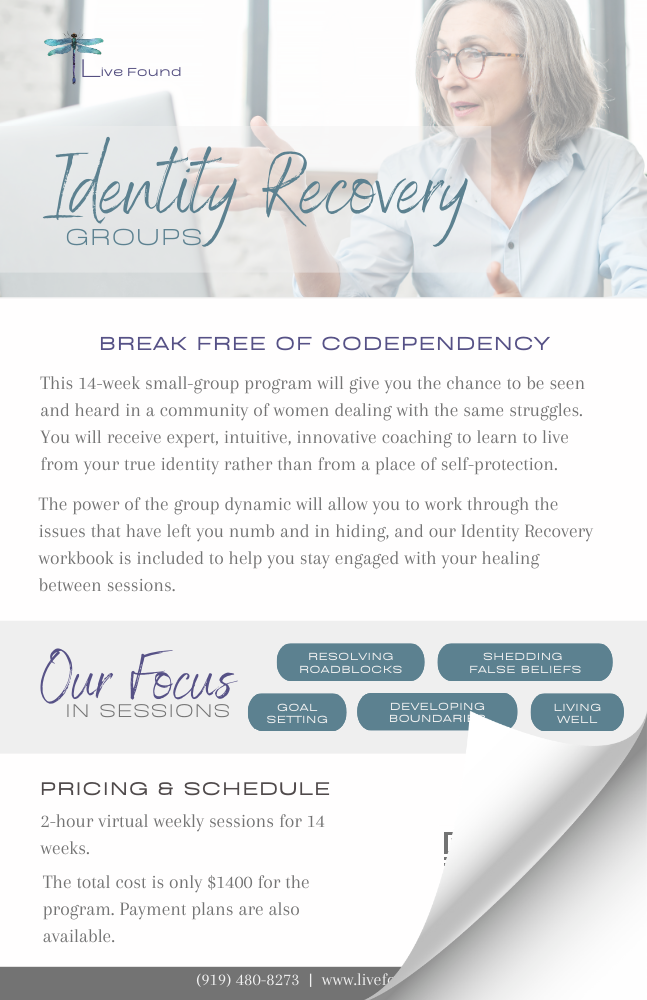
- Identity Recovery Groups: genuine witness, from women who know what it took to find the line again. Small on purpose.
- One-to-one coaching with me or Identity Recovery Coach Lauren Rose, when you want someone to help you tell whose voice is whose: booking portal.
Find yourself. Keep yourself.
About the author. Sharmen Elaine Kimbrough is an identity strategist and the founder of LiveFound, Inc. She holds a Master’s degree in professional counseling and spent more than ten years developing and leading the women’s programs at the Marriage Recovery Center. She writes for women recovering a self after emotional abuse, coercive control, and spiritual bypassing. More about Sharmen →