
Connecting with your kids when your marriage is hard can feel like one more thing you’re failing at. It isn’t. In the last post we covered what your children are already absorbing, and the three things to say out loud so they stop carrying it as their own fault. This one is about something else entirely — and I think it’s the piece that will surprise you.
Very likely, you’ve lived in the marriage as if the marriage was your identity. You haven’t been a person in the room, you’ve been absorbed into a unit that had no room for your “self.”
Your Children Have Been Relating to the Atmosphere
Think about what that means from where they stand.
They haven’t been relating to you. They’ve been relating to the thing in the middle of the room — the temperature, the tension, the state of the marriage. And because the marriage has been hard, they have experienced you as unavailable, even when you were standing right there making them breakfast.
That’s the cost. Not that your children saw too much. That they lost access to their mother inside a marriage that took up all the oxygen.
Here is the reframe:
The marriage is one relationship in that house. It is not the only one — and your relationship with each of your children is not downstream of it.
It’s its own thing. It has its own weather. And it is entirely within your power to build, regardless of what the marriage is doing.
Connecting With Your Kids: Ten Minutes, One Child, No Agenda
Start absurdly small, and start with one of them at a time.
Ten minutes. One kid. No correction, no life lesson, no fishing for how they’re doing with everything. Drive them somewhere. Fold laundry together. Sit on the end of the bed for a minute longer than usual.
The content does not matter. The separateness does. A child who has ten minutes that belong only to her has evidence that she exists as an individual — not as a member of a household, not as a piece of a situation.
And do it with each of them separately. Family time is not this. Family time is the atmosphere again.
Know Their Specifics
Not “how was school.”
The name of the kid who’s been difficult. The thing they’re building in the game. The song they’ve played nineteen times. What position they actually want to play.
Specificity is how a child knows she is genuinely seen rather than generally loved. And being accurately seen by one person is the most protective thing available to a kid in a hard house — the same principle from the last post, working from the other direction.
Stop Hiding Your Competence From Your Own Children
Women in your position hide what they know from their own kids.
You have language for what’s happening in relationships. You have tools. You have a hard-won, precise understanding of how people work — pressure, repair, respect, manipulation, what a real apology is — and it cost you years and a great deal of pain to acquire.
And you say none of it, because you’ve decided that teaching any of it would mean talking about their father.
It doesn’t. You can teach them how people work without ever discussing the marriage.
Right now your children are figuring out relationships the way every child in an unexplained house does: by watching and guessing. You can shortcut years of that. On ordinary days, in ordinary language, about anything other than him.
They don’t have to figure this out alone. That sentence is most of the job.
What You’re Actually Raising Them Out of
Here’s what concerns me about kids from difficult houses, and it isn’t that they’ll be naive.
They tend to go one of two directions.
Hypervigilant and hard. Excellent at reading a room, permanently braced, unable to rest in any relationship. She reads everyone — and trusts no one, including herself.
Compliant and blind. She learned early that noticing was dangerous, so she stopped noticing. She walks into adulthood with the radar switched off and no idea what she’s looking at.
Both are intelligent survival strategies. Both cost a life.
What you want instead is the thing this whole boundaries series has been about, one generation down: discernment without cynicism. Clear eyes and an open heart, at the same time, on purpose.
Your children can learn that at nine instead of at thirty-nine.
Teach the Pattern on Neutral Ground
Never about their dad. Use the book, the movie, the show, the story about somebody at school.
Why do you think he said that right then? What was she hoping would happen? Did that apology actually fix anything, or did it just end the conversation?
You are training the analytical muscle on material that costs them nothing — and it transfers completely. A child who can see a pattern in a story can see it in a hallway.
Give Them the Vocabulary
Pressure. Respect. Consent. The difference between an apology and a transaction. The difference between being nice and being kind.
Named things are portable. A child who has the word for something can see it coming for the rest of her life — which is the entire premise of everything I do here.
Let Them Practice “No” on You
This is the highest-leverage thing in this post and it costs nothing.
Let them refuse something — a hug, a food, a plan — and let it be genuinely, visibly okay. Don’t punish it. Don’t sulk. Don’t negotiate it away or make them pay a small social price for it.
A child who discovers that her no exists and survives contact with someone who loves her has learned something she will use at nineteen, in a dorm room, with someone you will never meet.
You cannot give her that lecture. You can only give her the experience.
And notice what this asks of you, because it is not nothing. It asks you to be refused by someone small, in your own house, on a day when you are already depleted, and to let it cost her nothing. If you grew up somewhere that a child’s no was treated as defiance, this will feel wrong in your body the first several times. Do it anyway. You are not being permissive — you are running a drill she will use under pressure for the rest of her life.
The Three Questions That Become Lifelong Equipment
Run these at dinner until they’re just how your family talks:
- What did you notice?
- What did you feel about it?
- What do you want to do?
Awareness, emotion, agency — in that order. It’s the same architecture I’d give you, scaled down to kid size. It teaches observation rather than suspicion, keeps the heart in the process rather than training it out, and it ends on her choice, which is where a life gets built.
And Let Them Love Him
This is the hard one, so let me be direct.
Their relationship with their father is theirs. Not yours. And it’s on its own timeline, which is probably longer than you’d like.
You don’t have to endorse it, correct it, or compete with it. Pressing a child toward your verdict reliably produces one of exactly two outcomes: a kid who defends him to you, or a kid who hides from you. Neither one is what you want, and both cost you the access you were trying to protect.
You are not asking them to agree with you. You are making sure that when they work it out for themselves — and they will — you are someone they can bring it to.
The Theology Underneath This
Jesus said something to people He was sending into genuine danger: be as shrewd as serpents and as innocent as doves (Matthew 10:16).
Both. Not a choice between them.
That is the exact assignment you have as a parent in a hard house — and the exact thing you are passing down. Shrewdness without innocence produces a hard, suspicious adult. Innocence without shrewdness produces one who walks into the next version of what you’ve lived. Your children need both, and you are uniquely equipped to teach both, because you have paid for the knowledge.
And underneath all of it: they are learning what a person looks like who keeps herself.
Not a woman who escapes. Not a martyr. A woman who knows who she is, holds what’s hers, and stays warm anyway.
Every boundary you hold in front of them is a demonstration. Demonstrations outlast explanations by about thirty years.
What’s Next
Connecting with your kids when your marriage is hard doesn’t wait on the marriage. You don’t have to have your marriage figured out to do any of this. That’s the point — this is its own thing.
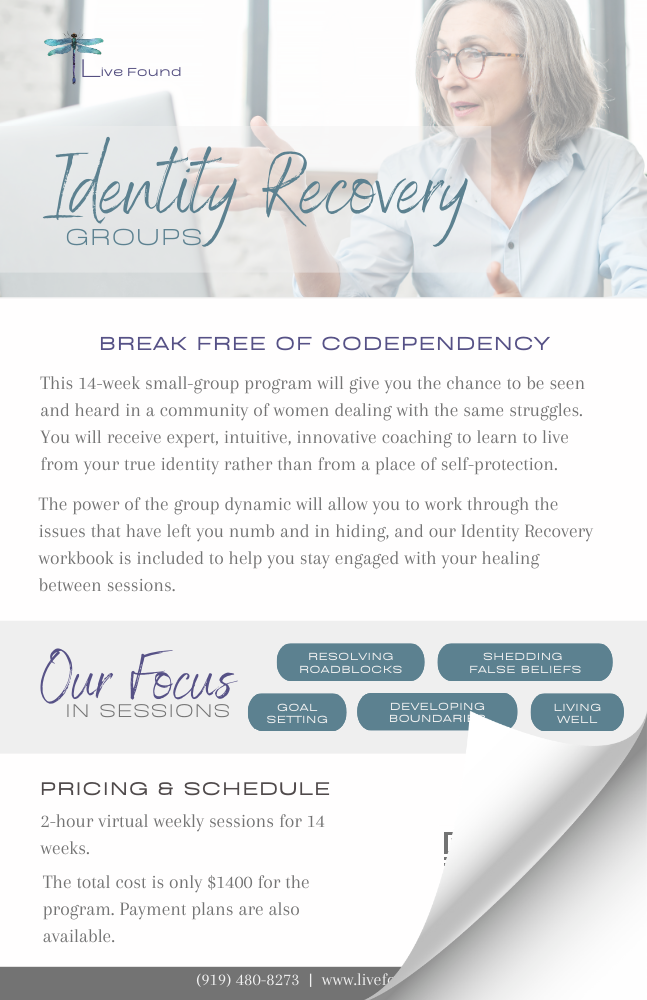
The Boundaries Course is where this becomes a daily practice instead of one good read. It’s self-directed, at your own pace, and built specifically for the woman who hasn’t left and may not be leaving. If you want a handler rather than a jury, that’s what the Identity Recovery Groups are for. They’re small on purpose, facilitated by me or by Identity Recovery Coach Lauren Rose. One-to-one sessions with either of us are available through the booking portal.
Not ready for any of that? Start with the Tools for Healing Journal. It’s the framework to help you put it all into practice.
Find yourself. Keep yourself.
About the author. Sharmen Elaine Kimbrough is an identity strategist and the founder of LiveFound, Inc. She holds a Master’s degree in professional counseling and spent more than ten years developing and leading the women’s programs at the Marriage Recovery Center. She writes for women recovering a self after emotional abuse, coercive control, and spiritual bypassing. More about Sharmen →