
You’ve been told that boundaries are unloving.
Maybe not in those words. Maybe it was gentler — a pastor wondering aloud whether a submitted wife makes demands. A counselor noting that ultimatums escalate things. A friend saying carefully that marriage requires sacrifice.
Or maybe it was him, and it wasn’t gentle at all. So you’re trying to control me now?
And somewhere in the middle of all that, you stopped being able to tell the difference between a boundary and a punishment. Between protecting yourself and abandoning him. Between guarding your heart and hardening it.
So before we get anywhere near what to say or how to hold it, I want to fix the definition. You cannot build well from a blueprint that’s missing something.
The Definition Nobody Gave You
Here is the sentence that should reorganize this for you.
A boundary is not something you place on him. It is a decision you make about you.
Read it again, because almost every fight you have ever had about boundaries came out of the other definition.
If a boundary is something you place on him, then a boundary is a demand. It requires his cooperation. It has to be negotiated, agreed to, enforced. It can be refused — and the moment he refuses it, you are standing in your own kitchen holding a rule nobody is following. Which feels exactly like powerlessness, because it is.
That was never what a boundary was.
A boundary is a line you draw around your own participation. It describes where you end and he begins. It governs your behavior — what you will do, what you won’t, what you’ll be present for and what you’ll step away from. It is not an instruction issued to another adult. It is a decision made about your own life.
Requests Are Fine. They’re Just Not Boundaries.
This distinction isn’t semantic. It’s the difference between a boundary that depends on him and one that doesn’t.
A boundary that requires his agreement isn’t a boundary. It’s a request.
And requests are good — a healthy marriage is full of them. Would you stop doing that. Would you speak to me differently. Would you come home when you say you will. Those are legitimate asks and you are allowed to make them.
But a request hands him the outcome. A boundary keeps the outcome with you. That is the entire shift.
Most of what you have been calling boundaries for years were requests. Repeated requests. Escalating requests. Requests with consequences attached that you didn’t follow through on, because following through would have cost you something you weren’t ready to pay yet.
That’s what happens when nobody ever handed you the right definition.
The Four Parts of a Real Boundary
Here is how to tell whether the thing you’re holding is actually a boundary. Notice how little of this involves him.
One: a limit that is genuinely yours
Not what a healthy woman would tolerate. Not what your counselor thinks is reasonable. Not what would look defensible if you had to explain it.
What you cannot absorb without losing access to yourself.
You can own your own thoughts, perceptions and decisions. You cannot own someone else’s opinion of you. Your limit is yours, and it is not up for a vote.
Two: an action you can take alone
This is the load-bearing part. If your boundary requires him to do anything at all in order to function, it is not yet a boundary.
I will leave the room when the yelling starts — an action you take alone. You will stop yelling — not an action you can take alone.
Same limit. Only one of them is yours to execute.
Three: a statement made once, plainly
You do not have to beg. You do not have to restate your case. This isn’t a trial, it doesn’t require a defense, and you are not writing a persuasive essay — because you are not seeking a verdict.
I’m not going to keep talking about this tonight. That’s a whole sentence.
And where saying it out loud isn’t safe, the statement still gets made — to yourself, on paper, to one safe witness. It has to be said somewhere. It does not always have to be said to him.
Four: it holds regardless of his response
This is where it becomes real, because his response will very likely be built to make you take it back. Anger. Wounded silence. Scripture. Tears. Threats of his own. An accusation that this is exactly what he always said you were.
The boundary survives all of it. Not because you have gone hard-hearted, but because its function never depended on his cooperation in the first place.
He is allowed to hate it. He is allowed to think you’re wrong. Neither of those changes what you do next.
One of mine, if it helps: “No” is a complete sentence. Nobody is entitled to my engagement. Not my explanation, not my defense, not my continued presence in a conversation that stopped being a conversation. Entitled is exactly the right word, and it’s the one nobody says out loud.
A Word About What This Isn’t
Four things get called boundaries and aren’t: the ultimatum, the wall, the limit you hold silently and never name, and the boundary you say but don’t intend to hold. Each of those has a specific failure mode, and I’ve written about all four in a companion piece coming soon.
There’s a fifth — the punishment — and it deserves more room than a list item, because it’s the accusation you are most afraid is true. That one has its own post. (Also coming soon! Subscribe to my newsletter and you’ll get the latest episodes without having to go digging for them.)
Why It Feels Wrong When It’s Right
You will set a good boundary, hold it well, and feel terrible.
Guilt. A low kind of nausea. The certainty that you’ve just done something unkind, unspiritual, unlike yourself. And because you are a woman with a functioning conscience, you will read that feeling as evidence — this feels wrong, so it must be wrong.
It isn’t.
Your conscience wasn’t shaped by this marriage. It was trained by it — over years, in a specific environment, by a specific person, toward a specific outcome. Trained to register your needs as selfishness, your limits as unkindness, your discomfort as sin, and his displeasure as proof that you are failing.
So the alarm now goes off in the wrong places. Guilt fires when you protect yourself and stays quiet when you abandon yourself.
You are allowed to feel guilty and hold the boundary anyway. In the beginning that will be the standard experience, not the exception. More on that here soon— because it derails more women than any external opposition ever does.
The Theological Anchor
This is where the boundaries conversation gets taken away from women of faith. I want to take it back.
God has boundaries. That should end the debate on its own, but let’s sit in it.
Scripture shows a God who loves unconditionally and sets terms — who states them clearly, holds them, and does not renegotiate under pressure. He is not less loving for having limits. His limits are one of the ways we know what He is actually like. His limits determine whether we spend eternity with Him. Those are boundaries.
Jesus withdrew. Repeatedly, and while there was still need in front of Him. He withdrew to lonely places and prayed — Luke 5:16 — while there were still sick people in that town. He went anyway. If unlimited availability were the standard of love, the incarnate Son of God failed it routinely.
And you were commanded to do this. Above all else, guard your heart, for everything you do flows from it. Proverbs 4:23. To guard is to place a watch — to set a boundary. It isn’t a suggestion or a concession to weakness. It’s an instruction. And the reason given is that everything else flows from what happens there.
You were not told to leave the gate open and call it faith.
Submission was never compliance
The theology you were handed collapsed two different words into one.
Submission is a mutual, chosen, Spirit-formed posture between two people who are both submitted to Christ. Compliance is what you produce under threat. They are not the same thing, and compliance under threat is not submission.
Love ceases to be love when free will is removed. That is as true theologically as it is relationally. God Himself will not force love. He extends. He invites. He waits. He permits refusal — because coerced love isn’t love, and He isn’t interested in a counterfeit.
A marriage that requires your compliance in order to function is not asking you for love. It is asking you for compliance and calling it love, because love is the harder word to refuse.
Ezer kenegdo
This is where the Hebrew matters more than almost any passage in the boundaries conversation.
It is not good for man to be alone, so I will make an ezer kenegdo for him. Usually translated “helper,” which does the phrase no favours at all.
It means a strong help corresponding to — standing opposite, a counterpart. The Hebrew carries the sense of a facing partner. A distinct presence. Someone with enough separate substance to actually stand across from him.
You cannot correspond to someone you have dissolved into.
So the boundary is not the opposite of your calling. A boundary is what makes your calling structurally possible.
Where to Start This Week
Four practices. Start with the first and don’t skip ahead — it’s basic on purpose, and it’s what makes the rest hold.
Find the limit before you announce it
Most boundary attempts fail because they get set in the middle of an incident, at maximum heat, in reaction. That’s not a boundary. That’s a flare.
So do it cold. On an ordinary afternoon, ask yourself:
Where in the last month did I leave a room, a conversation, or a day having lost access to myself?
Not where was I hurt. Where did I disappear.
Those spots are where your limits actually live. Write them down before you say a word to anyone.
The other three practices — the grammar test that turns a request back into a boundary, deciding your follow-through before you need it, and saying it once and then stopping — are in my next post (so please stay tuned!), because each of them is really the antidote to a specific way boundaries fail.
It’s My Road
Boundaries are the guardrails I put on the road I want to be on.
It’s my road. Not the road you were assigned. Not the road you’ve spent years managing someone else’s driving on. Yours — the one God actually gave you, with your name on it, that you are responsible for and nobody else can walk out for you.
A guardrail isn’t a wall. It doesn’t close the road. It doesn’t end the trip, and it doesn’t decide who else is in the car. It does exactly one thing: it keeps you from going over the edge on a curve you can’t see around.
You’re allowed to put those up.
You have been allowed this whole time. You just have to give yourself permission.
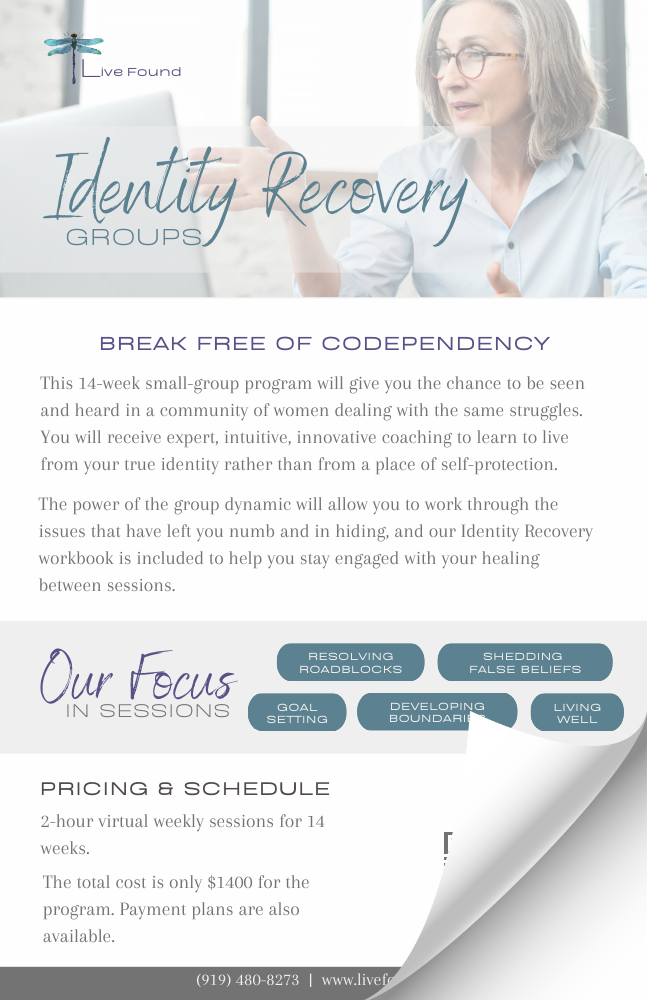
The boundaries course is the full, structured, faith-integrated version of everything in this series — self-directed, at your own pace, at two in the morning if that’s when you’re awake. If you’d rather do this work alongside other women giving themselves the same permission, that’s what the Identity Recovery Groups are for, and there are groups starting this month. One-to-one support is available through the booking page.
If all of this feels like too much at once, start smaller: the Emotional Check-in Worksheet walks you through your internal cues, what’s still true, and one small move. It’s free, and it’s the right first step.
About the author. Sharmen Elaine Kimbrough is an identity strategist and the founder of LiveFound, Inc. She holds a Master’s degree in professional counseling and spent more than ten years developing and leading the women’s programs at the Marriage Recovery Center. She writes for women recovering a self after emotional abuse, coercive control, and spiritual bypassing. More about Sharmen →