
Every boundaries book ever written assumes there’s a door you can close behind you.
Go no contact. Take space. Limit your exposure. Remove yourself from the situation.
And you’re reading that from the same bed. His keys are on the same counter. Dinner is at the same table in about three hours.
So the advice slides right off, and you land on the only conclusion that seems left: The problem is me. The strong women did that. I’m just not strong enough.
And somewhere behind that, the sentence nobody says to your face but everybody seems to think: If it were really that bad, you’d have left.
That is NOT what happened.
In fairness to the books, no contact is good advice… for a woman with an exit. You’re living a life that doesn’t have that door today. Taking advice built for somebody else’s floor plan and blaming yourself when it doesn’t fit your house isn’t weakness. It’s a category error, and you’ve been paying for it for years.
So here’s how to set boundaries when you still live together: advice built for the house you’re actually in.
A note before you read on. If you share a phone, laptop, or browser with him, read this in a private window or on a device he doesn’t use, and clear it when you’re done. Some of what follows only works if it stays yours.
(If you’d rather make this a daily practice than a one-time read, the Boundaries Course was built for the woman who hasn’t left and may not be leaving.)
You Are Not Trapped in That House. You Are Posted There.
I know how that sounds, like a mindset trick. A reframe designed to make a bad thing feel better.
It isn’t. It’s a completely different operational reality, and it changes what you do on any given day.
A hostage has no awareness, no training, and no mission. She waits. Everything that happens to her happens to her. She’s a product of her circumstances.
An operative in hostile territory has all three. She has awareness: she knows what’s going on, who he has proven himself to be, and where the exits are. She has training: she’s done the research and the reps, and she’s rehearsed. And she has a mission: she decided in advance who she is and what she’s there to do.
Same building. Same danger. An entirely different interior life.
Before we build that interior life, two stakes go in the ground, because a framework this strong can go wrong in two directions.
First, this is not a call to stay. Nothing here is a verdict on your marriage. I’m not going to tell you to go, and I’m not going to tell you to stay. That’s not my call, and anyone who makes it for you in a blog post is selling you something. But the woman who hasn’t decided yet still has to live somewhere, and she deserves to be someone while she decides.
Undercover is a posture. It’s not a sentence.
Second, this is not permission to become the war. An operative who becomes the thing she’s operating against has already lost, whatever else she accomplishes. So everything below stays inside your own integrity. You may plan, prepare, and hold back. You may keep a log, an account, a bag. You may not lie as a way of life, manipulate, or train your children in duplicity.
Stop Asking the Civilian Question
The civilian question is: How do I get him to stop?
You’ve been asking it for five years, maybe twenty. It’s a reasonable question, and it’s the wrong one, because you don’t have that lever. No amount of skill will produce it. Every article that tells you to communicate better or try “I” statements is handing you a conflict-resolution tool for something that was guerilla warfare. It’s selling you a lever that doesn’t exist.
The operative asks three different questions, and all three have answers you can act on today:
- What am I protecting?
- What am I building?
- What do I need to know?
Everything practical below comes out of one of those three. And watch the middle one. Most women in your position have never once been asked what they’re building. Only what they’re putting up with.
This is also why a boundary in a shared house works at all. A boundary is not something you place on him. It’s a decision you make about you. He doesn’t have to agree to any of what follows, because none of it is addressed to him.
Turn the Antenna Around
You already have the core skill, and it’s world-class.
You can read his mood from the sound of the car door. You know from three words whether tonight is survivable. They keep telling you it’s anxiety. You call it walking on eggshells.
It’s a trained intelligence capability, and it’s been deployed in service of his comfort, at your expense.
Here’s the distinction to make:
Hypervigilance scans his state in order to prevent it. It never stands down. It keeps him regulated so the house stays calm, which makes you a full-time emotional meteorologist for a climate you’ll never control. It serves him and costs you everything.
Awareness observes patterns in order to inform your decisions. It stands down. It’s calm because it isn’t trying to head anything off. It serves you.
Same faculty, opposite assignment. Managing him is infinitely unresolvable. Managing yourself is what it means to be living your own story.
Four ways to reassign it
Keep a log. Facts, not feelings. Dates, times, what was said or done, in plain words. The way a report reads, not a journal. Not “He was awful again,” but “Sept 24, 9:40 PM. Said I was destroying the family, in front of E. Left. Came back at 1 AM.” Keep it somewhere he can’t reach.
It does three jobs at once. It defeats the slow rewriting of your memory. It shows you a pattern you can’t see from inside a single week. And if it ever needs to be evidence: adjectives aren’t evidence. Dated specifics are.
Somebody will quote 1 Corinthians 13 at you here. Love keeps no record of wrongs. So let’s be precise. A record of wrongs is kept to punish someone later. This log is kept so you can see what’s in front of you. It’s a baseline of data against the fantasy you may have been holding on to.
Build a tell inventory. What reliably comes before an escalation? A specific tone. A certain hour. A phone call from a particular person. A drink. You already know these. Write them down, and they stop being dread and become data, which means you can make a plan instead of staying braced.
Know the terrain. Where the money is. Whose name is on what. Where your birth certificate, passport, and titles are. What your credit looks like. Not because you’re leaving. Because a woman who doesn’t know her own ground isn’t operating. She’s just present. Your assignment this month: get your own copies.
Do a weekly read. Ten minutes, same time each week. What did I observe? What do I know now that I didn’t last week? Then close the file and go live your day.
Awareness with a scheduled window stops colonizing every single hour.
And here’s the shift at the heart of all four: you’re not collecting this data to manage him. You’re collecting it so you can choose how deep to engage, on your terms.
Eight Pieces of Ground You Can Hold When You Still Live Together
You can’t control the front door. You can control more than you’ve been told. Each of these is available without his agreement or his permission. Pick two. Not all eight. Two.
A room, or a corner of one. A chair by a window. A closet. The bathroom with the door locked. Your car in the driveway. Somewhere your body knows is yours. It can be small. Small and real beats large and theoretical.
Time. A standing hour that’s spoken for. An early morning, a class, a walk, church without him, a shift. Claimed time is the most defensible ground there is, because it doesn’t need a room.
Your phone. A passcode he doesn’t have, notifications off the lock screen, sensitive conversations somewhere he doesn’t look. If changing a passcode raises the risk in your house, don’t. Use a different device: a friend’s, the library’s. There’s rarely only one way in.
Your money. An account in your name, at a bank he doesn’t use. Even small. Even slow. Options that exist only on paper can be ripped away at any second.
Your documents. Your own copies, stored outside the house. One afternoon of work, and it changes what’s possible later.
Your body. You’re allowed to say no inside a marriage. At any hour, for any reason, or for no reason at all. If you’ve been taught that submission means availability, I’ll say it plainly:
Consent is not suspended by a wedding. And a man who believes he’s entitled to your body didn’t learn that from Christ.
Your own friends. Not our friends. Yours. Isolation almost never shows up as a rule. It shows up as his mood after you see her. A remark that she’s “a bad influence.” A sigh every time her name comes up. Until it’s just easier not to go. So go. A standing coffee, a weekly call, a text thread he doesn’t read. A friendship you tend on purpose is ground he can’t annex.
The conversation. The one thing you can end in any house, with any floor plan. It’s the smallest boundary on this list, and it’s the one you’ll use most.
Hold your two for thirty days. A small boundary you actually keep does more than a large one you announce and never hold. You know your house. You pick.
Nobody Gets Sent In Without Training
You’ve been improvising your hardest moments, at your most flooded, against someone who has run this scene a thousand times. Of course it hasn’t gone well.
You’ve been doing live theater with no script, against a man who wrote the play.
Rehearse three lines until they’re boring. Pick the three scenes that actually happen in your house and say your line out loud in the car until it’s dull. (Here are the lines for the most common one.) Flooded people can’t compose. They reach for whatever’s already loaded, so load it in advance.
Drill the recovery. What do you do in the twenty minutes after? Most people skip this, and it decides whether you can do it again tomorrow. Cold water on your wrists. A walk to the mailbox. Four slow breaths in the car. One text to one person.
The wellness industry will call that self-care. In your house it’s more than that. It’s operational capability. A woman who can come down in twenty minutes has three more moves available than a woman who takes three days, or three weeks.
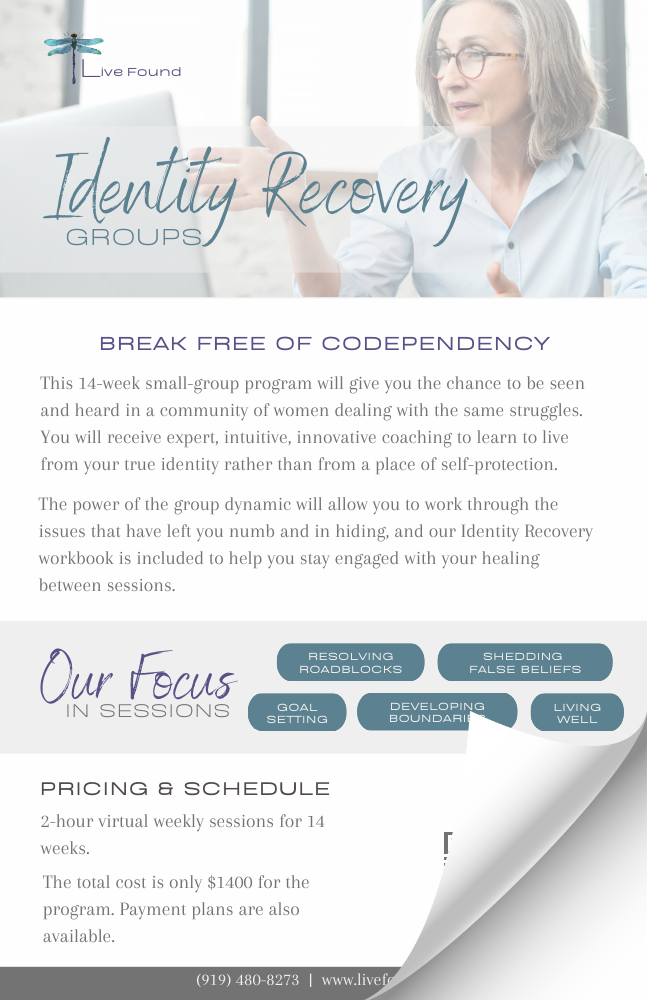
Have one handler, not a jury. The pastor, the elders, your family: that’s a panel you keep petitioning, and every hearing starts from scratch. A handler knows the whole picture, not the sanitized version. She remembers what you told her in March when you can’t, and she tells you the truth. For the record, that’s what our Identity Recovery Groups are for, and it’s why we keep them small.
Know your route. Somebody’s going to tell you a packed bag means you’ve given up. It doesn’t. Knowing the extraction point is not the same as using it. Where would you go tonight? Who answers at 2 AM? What’s in the bag, and where is it? Keep the National Domestic Violence Hotline (1-800-799-7233, or text START to 88788) somewhere you can reach it without searching.
People who know their exit make calmer choices about staying.
It’s the difference between having a decision and only having a reaction.
If you have children, all of this has a second layer: what they’re absorbing, and what they need from you. That deserves its own post. (Coming soon!)
So Here’s the Deal…
Three things, starting this week.
Write down the three questions and answer them. What am I protecting? What am I building? What do I need to know?
Start the log today. Dates, quotes, no adjectives, somewhere he can’t reach.
Pick your two pieces of ground and hold them for thirty days. You can add more later.
You know your house, and what all the cards are. You get to make your play when you’re good and ready.
But don’t skip the middle question. What are you building? Your steadiness. Your children’s grip on reality. Your degree, your business, your faith, your capacity to think clearly again. Nobody in that house is going to ask you, so I’m asking.
Because the hardest ground in a shared house isn’t a room. It’s what you hand him about yourself every day without thinking. That’s the next post: Sharing a Roof Without Sharing Yourself. (Also coming soon!)
Same building. Same danger.
An entirely different woman walking through it.
The Boundaries Course is where this becomes a daily practice instead of one good read. It’s self-directed, at your own pace, and built specifically for the woman who hasn’t left and may not be leaving. If you want a handler rather than a jury, that’s what the Identity Recovery Groups are for. They’re small on purpose, facilitated by me or by Identity Recovery Coach Lauren Rose. One-to-one sessions with either of us are available through the booking portal.
Not ready for any of that? Start with the free Emotional Check-in Worksheet. It’s the weekly read in structured form: your internal cues, what’s still true, and one small move.
About the author. Sharmen Elaine Kimbrough is an identity strategist and the founder of LiveFound, Inc. She holds a Master’s degree in professional counseling and spent more than ten years developing and leading the women’s programs at the Marriage Recovery Center. She writes for women recovering a self after emotional abuse, coercive control, and spiritual bypassing. More about Sharmen →