
“I just want us both to be heard.”
Somebody says it in the first ten minutes of almost every couples session. It sounds fair. You are both hurting, you both get airtime, both of your feelings matter.
Then the feelings start coming out. I feel disrespected. I feel controlled. I feel unappreciated. I feel like nothing I do matters.
Here is the problem: “I feel disrespected” is not a feeling. It is a verdict wearing a feeling’s clothes. And if nobody in the room knows the difference, a couple can spend years answering rulings as if they were wounds, apologizing for them, softening around them, rearranging whole personalities to fit them, and nothing changes. Because a verdict does not want to be understood. It wants to be agreed with.
Two Kinds of Hurt in the Same Room
Picture a composite couple. Call them Claire and Joe.
In this couple, Claire is the one who has done the work. Years of counseling, a shelf of books, softened startups and carefully timed I-statements. Somewhere along the way she closed. Not hostile, not cruel. Just closed.
Joe runs a company. A couple hundred people answer to him. At home he says, “I can’t ever get it right. I’ve apologized. How many more times do I need to say I’m sorry?”
Both of them are hurting. But listen to what each hurt is asking for.
His sounds like: I’m not respected. I’m never enough. Hers sounds like: I’m carrying everything alone. I’m lonely in my own marriage.
One kind of pain is asking for allegiance: agree with my version of me. The other is asking for partnership: carry this with me. It is king of the mountain versus climbing the mountain together. Even when her pain tips into demanding, demanding connection is still asking for us. Demanding allegiance is asking for me.
Splitting the difference between those two is not neutral. One is hierarchy. The other is relationship.
At Joe’s office, someone who won’t fall in line is insubordinate. At home, the same complaint gets filed under feelings, and it comes out as “disrespected.”
Why “I Feel Disrespected” Starts a Fight
Every one of those statements (disrespected, controlled, unappreciated, rejected) is a description of what someone else is doing, plus a ruling on why. That is an interpretation: an attribution of meaning and motive. It does not tell anyone what is happening inside you. It tells them what you have decided about them.
And you can argue with an interpretation forever. You disrespect me. No, I don’t. Yes, you do. Name one time. Just now, by arguing with me. You could have that conversation in your sleep.
Nobody can rebut “I’m ashamed.” Nobody has counter-evidence for “I’m scared” or “I’m lonely.” There is no argument against a real feeling. There is only a response to it, and the response is where connection gets built.
An interpretation wants a verdict. A feeling wants a witness.
Three Ways to Tell a Feeling From a Verdict
1. Listen for the -ED Word
Disrespected. Ignored. Controlled. Attacked. Judged. Manipulated. When the word describes something being done to you, it is an interpretation drawn from your own frame of reference. Everyone is entitled to an interpretation. It just is not a feeling.
The rule isn’t airtight. Frustrated, scared and embarrassed end in -ED too, and they sit much closer to real feelings, because the interpretation in them is about you rather than the other person. So use the sharper test.
2. The “By You” Test
Put “by you” on the end of the sentence. “I feel disrespected by you” works perfectly, so it is a verdict. “I feel lonely by you” doesn’t work at all, so it is a feeling. Marshall Rosenberg, in his work on Nonviolent Communication, called these “faux feelings.” They sound like feelings and function like accusations.
3. “I Feel Like…” and “I Feel That…”
Whenever like or that follows “I feel,” a thought is coming. Swap in “I think.” “I feel like you don’t care” becomes “I think you don’t care.” If the sentence still works, it was a theory all along.
What Is Actually on the Floor
When you get all the way down, there are not many feelings. Pia Mellody names a short list of core feelings (anger, fear, pain, joy, passion, love, shame, guilt), and Chip Dodd’s The Voice of the Heart echoes the same idea. Nearly everything else is either a flavor of one of those or a story about somebody else.
Here is a starting translation. These are possibilities to check against your own heart, not answers to adopt.
| The verdict | What it says about him | What might be underneath, in you |
|---|---|---|
| Disrespected | He is treating me as less | Hurt. Ashamed. Angry. |
| Ignored | He chose not to notice me | Lonely. Sad. |
| Controlled | He is running my life | Afraid. Angry. |
| Unappreciated | He takes me for granted | Sad. Lonely. Hurt. |
| Rejected | He doesn’t want me | Hurt. Afraid this is permanent. |
| Criticized | He is attacking me | Ashamed. Afraid of being too much. |
Notice what happens to the room when the last column gets said out loud. There is nothing to argue with. There is only something to respond to.
Here is where this gets misused, so let’s close the loophole. Calling something a verdict does not make it wrong. Sometimes he is running your life. “Controlled” may be the most accurate word in the house.
The point is not that your read is false. The point is that feelings and verdicts do different jobs. Feelings are for connection: they let someone know you. Verdicts are for decisions: what you will allow, what changes, what you do next. Trouble starts when one is asked to do the other’s job.
And if “controlled” is accurate, you do not need him to agree with it to act on it.
Where the Verdict Started
This is the oldest move there is. In Genesis 3, God walks in the garden and asks a hiding man, “Where are you?” And Adam gives the first honest feeling statement in Scripture: “I heard you in the garden, and I was afraid because I was naked; so I hid.”
First person. True. Then, two verses later: “The woman you put here with me, she gave me some fruit.” From a feeling to a verdict in a single breath, aimed at her and at God.
Notice what God does not do. He doesn’t argue with Adam’s interpretation. He asks more questions. God’s first move toward a hiding man was a question. Curiosity is an invitation to come out and answer for yourself.
Proverbs 18:2 describes the alternative: “Fools find no pleasure in understanding but delight in airing their own opinions.” That is a verdict. “My truth,” with the door locked from the inside.
Adam did not only hide behind a tree. He hid behind a sentence. A verdict is a fig leaf made of words.
Most of us learned verdict language from the people who used it on us, and we kept it because it felt safer. “I’m lonely” leaves you exposed. “You ignore me” at least gives you something to stand behind.
The cost is that the real thing never gets said. You can spend ten years arguing about whether he ignores you and never once say you are lonely. Then you lose the argument and conclude you were never heard. You weren’t. You never got to the part that could be.
Naming the feeling does not mean handing it to him. You still choose your depth. The first person who needs to hear “I’m lonely” is you.
And when the verdict is aimed at you? You do not have to accept the ruling, and you do not have to appeal it. Ask the garden question: “What happened in you just now?” If he can find hurt or fear underneath, there is finally something to respond to. If all that comes back is a longer verdict, that is information too.
This Week: Catch One
Just one, and your own. Find the -ED word. Put “by you” on the end. If it fits, go looking for what is underneath it, and write the real feeling down.
You can build with a feeling. You can only defend a verdict.
If you are the woman who keeps hearing “disrespected” aimed at you, there is a second half to this: what to do when the verdict word is yours, and accurate. That post is on its way: My Husband Dismisses My Feelings: What “Dismissed” Doesn’t Say About You (coming soon!).
What’s Next
The Emotional Check-In Worksheet — free. A structured way to get from the verdict word to the feeling underneath it.
The Relational Reset — for couples, three hours with me: an hour with each of you, then one together. This is where couples work begins.
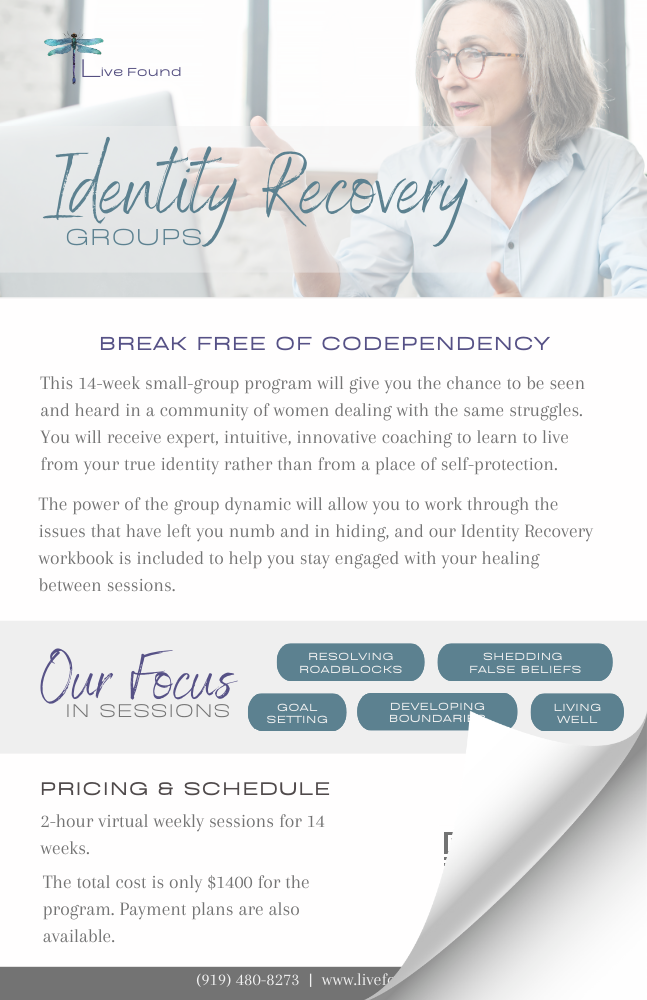
The Identity Recovery Groups — mine and Lauren’s. Women who will hear the feeling, not argue the verdict.
The Jumpstart — three focused hours, one-to-one, for the conversations you are actually having.
Intensives — one to five days, in person, when a season calls for depth.
The Private Strategy Retainer — for women who lead and want a strategist in their corner. Seats are limited, so each one gets my full attention. If that is the seat you want, apply.
Find yourself. Keep yourself.
Sharmen Elaine Kimbrough is an identity strategist and the founder of LiveFound, Inc. She holds a Master’s degree in professional counseling and spent more than ten years developing and leading the women’s programs at the Marriage Recovery Center. She writes for women recovering a self after emotional abuse, coercive control, and spiritual bypassing. More about Sharmen →