
You have tried to explain it.
Maybe to a pastor, or a counselor, or your sister. You sat down having rehearsed it, because you knew you’d only get one shot at making it make sense. And somewhere around the third sentence you heard yourself — describing a sigh, a silence, a birthday he forgot — and watched the person across from you wait for the part where something actually happened.
Then you did the thing you always do. You softened it. I know it doesn’t sound like much. And you left with less than you came in with.
That conversation is its own injury, and it has almost nothing to do with the quality of your explanation.
It is not that you can’t explain it. It’s that you have been trying to prove something that was built not to be provable.
The Disguise is the Whole Design
Here is what most content on this subject never quite gets to, and it is the part that matters most for a woman in a faith community.
Every behavior in the covert cluster has a virtuous twin. And in a church context, the twin is not just similar — it is admired.
- The martyrdom looks like servanthood.
- The victim position looks like long-suffering.
- The withdrawal looks like a man who needs space for prayer and reflection.
- The passive aggression looks like a peacemaker who simply doesn’t want to fight.
- The years-long resentment looks like a man genuinely wounded, doing the slow work of forgiveness.
- The performed empathy looks like a man who is trying — imperfectly, but with good intentions.
So when you bring your concern to someone, what they see is a husband who presents as humble, wounded, sincere — genuinely baffled by your unhappiness, or tired from carrying it, with an account of things that is articulate, composed, and entirely sympathetic.
And standing next to him: you. Distressed, reactive, struggling to describe something that from the outside has no obvious shape.
He is composed because nothing is costing him. You are distressed because everything is. And the room reads that backwards every single time.
That asymmetry is not a failure of your vocabulary. It is the predictable result of a pattern whose entire operating principle is that it does its work where no one is looking.
Quit Begging Others to See the Truth
I say this to women often and I want to say it carefully, because it can sound like resignation and it is the opposite.
Quit begging others to see it.
Not because the truth doesn’t matter — it matters enormously. But because this disguise is effective enough that the audience he performs for will frequently not see it at all. And when you make their seeing it the condition of your own clarity, you have handed away something that was never theirs to hold.
Think about what that arrangement requires: that a person with a fraction of your information, none of your history, and a twenty-minute impression of a man who is very good at twenty-minute impressions gets to decide whether fifteen years of your daily lived experience is real.
You would never accept that standard for anyone else’s life.
You can know what you know without the audience — without the pastor, the counselor, or the mutual friend finally saying the sentence you’ve waited years to hear. That knowing is yours. It always was.
The question is not “is he a covert narcissist?” The question is “what am I going to do with what I’m living?”
Six Tools That Give Your Life Back to Itself
None of these are designed to fix him. They are designed to return the interior resources that have been redirected into managing him.
1. Stop explaining. Start deciding.
The most consistent pattern I see is the investment in explanation. If I can just find the right words, the right moment, the right framework — he’ll understand. And then obviously he’ll want to change.
But empathy-based persuasion has a ceiling here, because genuine empathy is the core deficit. Appeals that require him to imagine himself in your position tend not to produce lasting change — not because your appeals are inadequate, but because the faculty required to genuinely receive them is not reliably available.
This doesn’t mean you never communicate. It means you stop spending most of your energy making him understand, and start spending it deciding what you’ll do regardless of whether he does. Your own needs, your schedule, your care, your life — those decisions don’t require his understanding. They require your clarity.
2. Name the behavior, not the person
When something needs addressing, be precise about the behavior — never his character, motives, or diagnosis. He’ll argue every one of those and he’ll win, because character is slippery terrain and you cannot prove an interior.
Not: “You’re passive-aggressive.” Not: “You never follow through because you don’t actually care.”
Instead: “When you make a commitment and don’t follow through, I get confused. I want to be able to rely on what you say.” Or, at its simplest: “You let the door close on me when I was right behind you. I need you to notice when I’m behind you.”
This keeps you out of a diagnostic argument you cannot win, and inside the only territory that is actually addressable.
3. Stop managing the martyrdom
This requires practice, and at first it will feel unkind — which is exactly why it’s so hard for a woman with a real conscience.
When the performance appears — the sigh, the weight, the unspoken burden — stop chasing it. Stop noticing it out loud. Stop asking what’s wrong. Not because you don’t care, but because your pursuit is the oxygen the martyrdom runs on. It confirms that a silent performance of suffering reliably produces your attention, your concern, and your labor.
Met with neutral acknowledgment instead of pursuit, it loses its function. Not immediately, and not without pushback. But behavior that stops working tends, over time, to fade.
4. Build a non-anxious presence
This cluster functions — whether by design or not — by keeping you in a state of mild chronic anxiety about the relationship and your role in it. The anxiety is the mechanism of your management. A calm woman is significantly harder to manage than an anxious one.
A non-anxious presence is not coldness or detachment. It’s the practiced ability to stay in your own emotional skin regardless of the atmospheric pressure in the house — a heart at rest, which is my actual definition of success.
It sounds like: He’s in a difficult mood, and that’s his experience to have. I’m going about my day. I’ll be available if he wants me. I’m not going to chase him.
5. Distinguish empathy from absorption
You are very likely a highly empathetic person, and that capacity is one of the reasons this has worked on you for so long — it has been recruited into the full-time management of someone else’s interior weather.
Empathy is the ability to understand and share another person’s feelings, held alongside the clear understanding that those feelings belong to him. It’s a gift, and one of the best things about you.
Absorption is when his state becomes yours. His anxiety becomes your anxiety. His dissatisfaction becomes your inadequacy. His sulking becomes your guilt.
Empathy says: I see that he’s struggling.
Absorption says: his struggle is my emergency, and mine to solve.
Your empathy is not the problem. Its total redirection toward him, at your own expense, is the problem.
6. Build an internal reference system
If you consistently feel blamed, drained, or as though your needs don’t register — that experience is data.
Not a diagnosis, not a verdict. Information. The exhaustion that never resolves. The sense of falling short of a standard you were never given. The loneliness of being with someone present in the room and absent everywhere that matters. Your longitudinal experience of this relationship is information, and information belongs in your decision-making.
So build the habit of checking in with your own experience, not just his. What do I feel today? What do I need? What’s my capacity? What is happening in my body and my soul as a result of living inside this dynamic?
Your Longing Is Not the Problem
I want to close with the woman who has been told — by her community, her theology, or the voice in her own head that has absorbed too much of someone else’s narrative — that she is the problem. That her sensitivity is the issue. That a woman with more faith, more grace, more patience wouldn’t be struggling like this.
Here is a different frame.
God is a God of genuine connection. The entire Trinitarian nature of God — Father, Son, Spirit — is a community of mutual, other-centered relationship. And the design for marriage that flows out of that is not cohabitation. Not functional management. Not two people living parallel, disconnected lives in one house. It is knowing and being known.
That design is not a guilt trip about the gap between your marriage and the ideal. It’s a North Star — evidence that the longing you feel is not spiritual immaturity but a soul that knows what it was designed for and is accurately registering its absence.
Your longing is not the problem. The absence of genuine connection is the problem. And a God who designed you for connection is not asking you to pretend its absence is enough, or to perform a contentment you don’t have. He’s asking you to be honest — with Him, with yourself, and with whatever safe person you have — about what you’re actually living, so you can find your next step.
Truth leads to life. Even when it’s uncomfortable. Even when it asks something of you that you’re not sure you’re ready for.
You are not too sensitive. You are not asking for too much. You are a person whose soul is faithfully registering the absence of something it was built to have — and that signal deserves to be taken seriously.
You should not have to keep describing this alone.
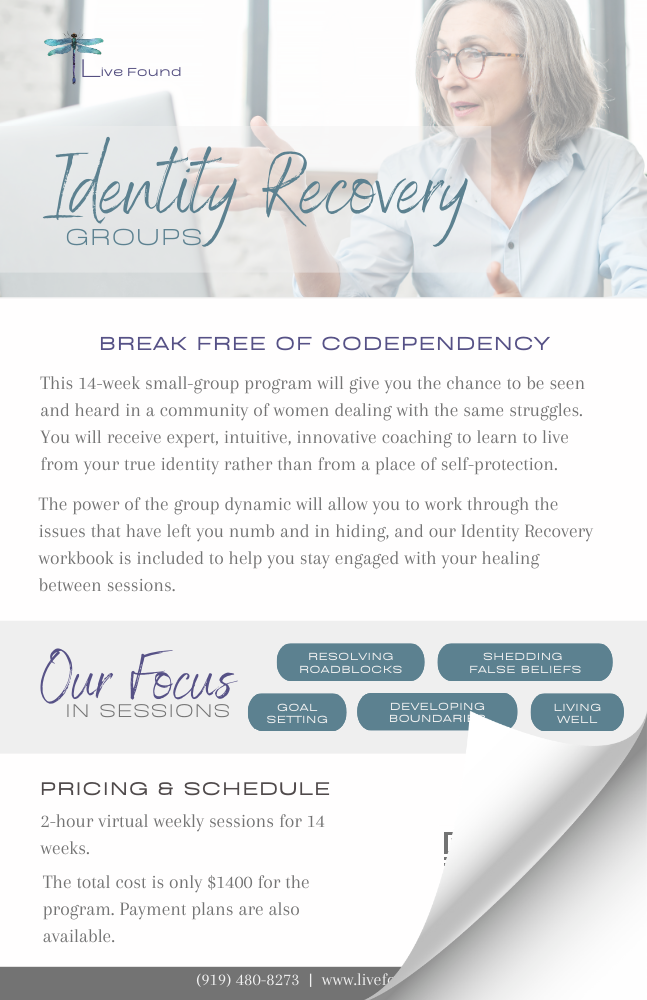
The hardest part of this pattern is not the pattern. It’s the isolation of living inside something no one around you can see. Identity Recovery Groups are a room full of women who do not need the shape explained to them — who know exactly what it is to have a story that sounds like nothing and costs everything.
Will this work for someone like me? If you’re still married, still unsure whether it’s “bad enough,” still hoping he’ll come around — yes. This is built for the woman in the middle. It does not require you to have made a decision about your marriage, and it will not make one for you.
What’s the risk — what are you not telling me? This: when you stop explaining, stop chasing the martyrdom, and stop absorbing his state, the dynamic gets louder before it gets calmer. Someone who has relied on your management will push harder when the management stops. That’s not the work failing — it’s the work landing. But you should know it’s coming, and you shouldn’t be alone in it. That’s most of why the group exists.
This is also the work the boundaries course was built for — not scripts to win arguments, but the framework underneath them. And if you would rather not practice it alone, the Identity Recovery Groups are women doing exactly this, together.
About the author. Sharmen Elaine Kimbrough is an identity strategist and the founder of LiveFound, Inc. She holds a Master’s degree in professional counseling and spent more than ten years developing and leading the women’s programs at the Marriage Recovery Center. She writes for women recovering a self after emotional abuse, coercive control, and spiritual bypassing. More about Sharmen →