The word withdrawal is not a metaphor here, and it is not an insult.
If you read the first half of this pair, you know the mechanism: harm produces cortisol, intermittent warmth produces relief, and your brain files that relief as a reward it can only get from one source. You know that the unpredictability is not a flaw in the pattern but the engine of it. You know from Cambridge’s 2025 research that this gets built on purpose, before any visible violence begins.
So when you try to step back — from the relationship, or just from the exhausting work of managing it — what arrives is not simply sadness. It is something closer to physical distress. That’s why leaving feels like withdrawal. Not as a figure of speech – as a description of what your nervous system is actually doing. Restlessness. A pull toward the phone. The 2am certainty that if you could just talk to him, this feeling would stop.
Here is the reframe:
You are not detoxing from love. You are detoxing from a schedule.
And the grief of a nervous system losing its conditioned source of relief is not the same thing as the grief of leaving something good — even though, from the inside, at three in the morning, they feel exactly alike.
The Bond is Not a Verdict On the Relationship
This is the single most practically useful distinction I can give you, and it is almost entirely absent from the popular conversation.
The bond and the relationship are two different things.
The bond is what your nervous system has been conditioned to feel. It is real. It is powerful. And it does not require a good relationship in order to exist.
In fact it frequently exists in inverse proportion to the quality of the relationship — because the more harmful the dynamic, the sharper the contrast between cruelty and warmth, and the more powerful the intermittent reinforcement. It feels like passion. It is closer to a variable-ratio schedule wearing passion’s clothes.
The relationship is what is actually on offer between two people. What is genuinely present. What the ordinary daily reality of being with this person actually provides for the life of your soul.
You can be deeply bonded to someone and be in a profoundly harmful relationship. The strength of the pull is not a rating of the thing you’re being pulled toward.
They are separate data streams. And if you are going to make a grounded decision about your own life — whether that decision is to leave, or to stay and rebuild, or to hold still while you watch — you are not just allowed to look at both. You are required to.
When “Soul Ties” Becomes a Containment Strategy
I don’t think the secular content on trauma bonding ever touches on this, but for a woman of faith there is a whole additional layer here, and it makes the bond harder to name and much harder to move inside of.
In Christian circles there is a concept called soul ties. In its genuine, rightly applied form, the theology is pointing at something true: that two people in covenant become spiritually knit together in a way that goes past the merely functional. Covenant is real. Union is real. The spiritual dimension of marriage is real and it is sacred. I am not interested in flattening that.
Here is where it gets weaponized.
When a woman begins to recognize that a relationship is harmful — when she begins to consider creating some distance, or leaving, or even simply ceasing to be fully emotionally available to someone who has been using her emotional availability against her — the soul-tie framework gets deployed as a containment strategy.
It sounds like this:
- You’re spiritually bound to this man. To separate from him in any way is to tear apart what God joined.
- The pull you feel toward him is your spirit recognizing the covenant. To resist that pull is to resist God.
- The grief you feel when you create distance is the soul tie breaking. You need to submit to the bond.
However, the grief of leaving a trauma bond is not the soul recognizing a holy covenant. It is a nervous system in withdrawal from its conditioned source of relief.
Those are two entirely different phenomena. And using the language of sacred covenant to describe what is actually a conditioned attachment response is one of the most sophisticated forms of spiritual bypassing I know of — because it takes the evidence of the injury and re-labels it as evidence of the obligation.
Real is not the same thing as holy
Your grief is real. The pull is real. The sense that separating might genuinely destroy you is real at a neurological level — that is honestly what your body is reporting to you.
Not every bond that feels sacred is one God designed. Intensity is not the same as covenant. A feeling can be entirely genuine, entirely overwhelming, entirely embodied — and still be the product of something that was done to you rather than something God asked of you.
You can take your own grief entirely seriously and still refuse to read it as a verdict.
Why Leaving Feels Like Withdrawal: Six Tools That Work on the Pull
Understanding the mechanism is step one. Here is step two — and these work whether you are leaving, staying, or sitting in the limbo of a story you did not choose.
1. Build new pathways on purpose — this is deprogramming, not self-improvement
If the bond was built neurologically, then healing is not a matter of insight or willpower. It is a matter of laying down new pathways: new associations, new experiences of safety, new sources of the dopamine and oxytocin and genuine soothing that your nervous system has been trained to expect from exactly one person.
Hold onto the word deprogramming. It reframes the entire project. You are not fixing a defect in yourself. You are undoing a conditioning that was installed.
And this is precisely why community is not optional in this work.
Your nervous system cannot learn in the abstract that other sources of genuine connection and relief exist in the world. It has to experience them — repeatedly, safely, consistently, over time. That is what a corrective emotional experience is, and you cannot have one alone in a room.
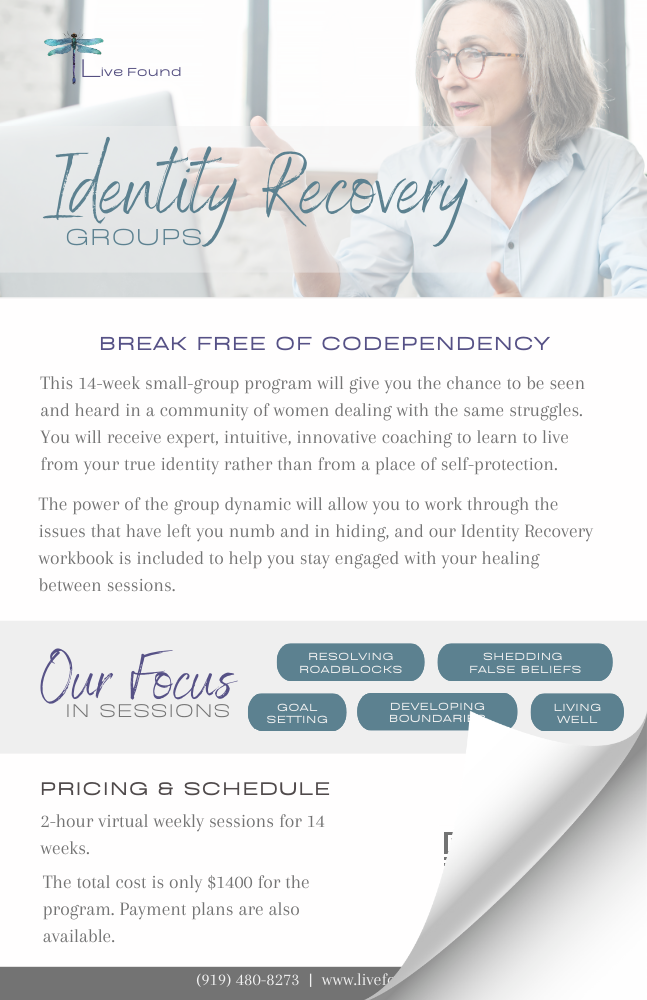
This is a large part of why the Identity Recovery Groups exist. It is also why one genuinely safe, consistently present friendship is worth more in trauma bond recovery than almost any amount of reading.
2. Stop arguing with the pull
You’ve been told the finish line is not loving him anymore. It isn’t, and chasing it will exhaust you.
That is not the goal, and chasing it will exhaust you.
The goal is learning that attachment is not an instruction.
- You can miss him without contacting him.
- You can grieve without reversing a decision.
- You can feel connected without concluding the relationship is healthy.
- You can long for something and still see clearly that it is not good for you.
The pull is real. The grief is real. The attachment is real. But feelings are information, not direction. You do not have to argue with every feeling, and you do not have to suppress it either. You simply stop treating each one as a command to do something.
3. Learn the cycle so you can see it coming
The bond runs on a cycle: harm creates distress, sporadic kindness or remorse creates relief and hope, your brain scores the relief as a reward, and the bond gets a little stronger despite the harm.
When you can see the cycle while you are inside it, it loses some of its power. Not all of it — I won’t oversell this. But some. Because now you are watching a pattern instead of only experiencing one.
The warmth that follows the cold is not evidence that things have changed. It is the reinforcement cycle completing itself, on schedule. The warmth is genuinely warm. It is just not new information.
So keep the whole cycle, not just the current frame. Write it down if you need to — not as a case to build against him, but as a record complete enough that your nervous system, in the moment of relief, can still be reminded what it is standing in the middle of.
4. Separate the craving from the need
When the urge to reconnect hits, slow down long enough to ask one question — and notice that it is a what question, not a who question:
What am I actually needing right now?
Reassurance? Comfort? Safety? Belonging? Hope? Understanding? To be seen?
The need underneath the craving is almost always legitimate. The problem is that your nervous system has become convinced that exactly one person can meet it — and that person is the one who has been harming you.
Name it out loud and the options reappear. Not self-care — the actual need. If it’s proof you aren’t crazy, that’s a person, not a bath. If it’s the sensation of being chosen, that’s a different person and a different conversation. If it’s the drop in adrenaline, that’s your body and it will take twenty minutes.
Agency starts coming back the moment you realize the need is valid even when the solution you’ve been reaching for isn’t.
5. Distinguish the bond from the relationship
We covered this above, and it belongs in the tool list too, because it is a thing you do, not just a thing you understand.
When you are evaluating your marriage, run two columns, and do not let them contaminate each other.
- The bond: how strongly do I feel pulled? How much does the thought of separation hurt?
- The relationship: what is actually here? What does an ordinary Tuesday with this person give to the life of my soul?
The first column tells you about your conditioning. The second tells you about your marriage. Only one of them is evidence about him.
6. Let grief be grief without letting it be a verdict
When the bond begins to loosen, grief arrives. And here is something the trauma-bond conversation almost always misses.
Part of your grief is not because you were made for abuse. Part of your grief is because you were made for attachment.
Human beings are built for lasting attachment. Built to bond. Built to make meaning around relationships and to become genuinely intertwined. So when a bond is threatened, broken, or severed, everything in us protests — not because the relationship was healthy, but because separation itself is painful. Unbonding hurts. It was never something we were designed to experience.
Understanding that changes the question you’re asking.
Instead of why does this hurt so much if leaving is right? you begin asking: why wouldn’t this hurt?
The pain of separation is not proof that you belonged there. It is evidence that you are human.
The God who designed the system that was used against you
I want to close where I always want to close. Not in the breezy everything will be fine sense — in the weight-bearing, El Roi, I see what has been done to you sense.
God designed the attachment system that is now causing you this much pain.
He designed oxytocin. He designed the human capacity for bonds so deep that their breaking feels like dying. He designed pair bonding and covenant and the profound reality of becoming genuinely known by another person. He designed all of it, on purpose, because He designed human beings for a quality of connection that mirrors His own relationship with His people.
The design is not the problem. The design is beautiful.
The problem is what happens when that design — that exquisite, God-given, neurologically embedded capacity for deep attachment — gets exploited. When a system created to bond you to someone who would cherish you is hijacked to bond you to someone who would harm you.
That is the violation. Something made for love and love alone, turned into captivity.
And then He watched it happen. I do not believe He is neutral about that.
The God who is after your heart — not your compliance, not your performance, not your endurance of something that is systematically dismantling the person He made — is not the author of the bond that is holding you. He is not the one asking you to honor it at the expense of everything He made you to be.
He is the one who sees the engineering. Who knows the playbook that was run on you. Who understands, at a level well past neuroscience, what it has cost you to be made to love someone who used your love against you.
And He is the God who heals. Not by magic, and not by erasing pathways that took years to lay down — but by the slow, consistent, grace-infused work of building new ones. By introducing your nervous system, through His presence and through safe community and through the gradually accumulating experience of real connection, to sources of relief that do not require your harm as the entry price.
He did not open your eyes to this in order to leave you hanging in it. He opened them so you could see. What you do with what you see is the ongoing, sacred, deeply personal work of the life of your soul.
Say this back to yourself
Your attachment is not the enemy.
Your attachment system was exploited.
You were created for bonding, and the unbonding hurts. That pain is not proof you belong there. It is proof you are human.
What’s Next
There’s a version of this advice that ends with be gentle with yourself, and you have read it, and it did nothing. Here is the working version.
Tool one is the one that moves anything, and it is the only one you cannot do by reading. New pathways get built by repetition — the same way the old ones did. What changes is who selects the inputs. For years that was him, on his schedule. Now it is you, on yours. That is not a smaller project than leaving. Most of the time it is the larger one, and it is the one that holds whether you go or stay.
Tools for Healing, my guided journal, is where to start if you want something in your hands tonight. It is built for exactly this kind of week.
The Boundaries Course is the structured build — self-directed, at your own pace, written for the woman who has not left and may not be leaving.
The Identity Recovery Groups are the repetition itself: a room of women who understand the pull without needing it explained, every week. That is what a corrective experience actually looks like in practice, and it is not something a book can do for you.
And if you would rather have someone holding the whole picture with you instead of the sanitized version, that is one-to-one — with me, or with Identity Recovery Coach Lauren Rose, through the booking portal.
You already know how to run a long project under pressure. This is one of those. The difference is that this time the thing being built is you.
Find yourself. Keep yourself.
About the author. Sharmen Elaine Kimbrough is an identity strategist and the founder of LiveFound, Inc. She holds a Master’s degree in professional counseling and spent more than ten years developing and leading the women’s programs at the Marriage Recovery Center. She writes for women recovering a self after emotional abuse, coercive control, and spiritual bypassing. More about Sharmen →