
When You’re Not Sure You Even Care
If you’re at your wit’s end — if your give-a-damn meter is broken and you almost don’t care anymore — you already know it’s the last chance, even if you haven’t said that out loud to anyone. At this point, a feeling isn’t enough. You need the experience to actually be different, and a sense of direction you can count on.
You’re not crazy for wanting proof. You’re not unforgiving or bitter for needing more than words and a promise. You watched someone use words as a weapon for years — of course your body doesn’t trust a sentence anymore. It wants a pattern that proves the direction has changed.
And here’s the part that’s hard to say out loud: you can be hoping for the miracle of restoration and feel absolutely nothing when he walks into the room. Not longing. Not warmth. Not even anger. Just quiet. Numb.
That dissonance is not a sign something’s wrong with your faith, your femininity, or your capacity to love. It’s what happens to a heart that’s been asked to stay open in an unsafe space for a very long time. Your heart closed to protect you. That was wisdom, not failure.
We’re going to talk about three things: what real change actually looks like — measurable, not emotional, something you can count on when you don’t trust your own read anymore; what to do with a dead heart and a skeptical, trauma-trained body while you watch for it; and underneath all of it, the quieter ache for a different life that’s been sitting in you, waiting for permission to be real.
The 7 Signs of Real Change
Real change doesn’t announce itself. It leaks out in the tense someone uses, in the specifics, in what they do when no one’s applauding them for it — and especially in what happens the moment they don’t get what they want.
Sign 1: The Tense Changes
“I’m going to work on this” is a plan — future tense. A promise costs nothing and proves nothing. It’s the cheapest thing a person can hand you, because it asks nothing of them today while it asks everything of you.
“I’m working on this, and here’s what came up this week” is a practice — present tense. That’s the only tense where change actually lives.
A useful question: the next time someone tells you they’re changing, ask, “What did that look like yesterday?” Not five years from now. Not when things settle down. Yesterday. A person with a real practice has an answer. A person with a good intention pauses and continues future-faking.
Sign 2: Their Thinking Becomes Visible
Real change exposes its own work. A person who’s actually growing shows you how they’re wrestling with it: “I noticed I did this thing again, and here’s what I think is underneath it, and what I’m doing differently.”
Someone still hiding needs you to believe the projected outcome. Someone changing needs you to see the process — because they’re not performing for you anymore.
Watch for whether their insight is about themselves, or whether it’s still, underneath, about managing you. “I realize I’ve been distant,” said to explain their own growth, is different from the same sentence said to get you to stop being upset.
Sign 3: Behavior Turns Active, Not Passive
Watch what they do with their own agency — not toward you, but toward their whole life, direction, and purpose. A person who’s only ever active at you — chasing, apologizing, love-bombing — but passive everywhere else, isn’t changing. They’re managing a relationship.
Ask: do they have goals that exist independent of what you’ve asked of them right now? Are they building friendships, disciplines, a faith practice — that aren’t in direct response to a fight? Passive people wait for the next crisis to tell them who to become. Active people are becoming someone with or without the crisis.
Sign 4: What Happens When You Say No
This might be the single most honest test there is. Anyone can hold a new direction when it’s working for them. Watch what happens the moment it isn’t — the moment your no, your boundary, your delay gets met with the old pressure, the old sulking, the old resurrection of every past grievance.
Real change isn’t tested by the easy days. It’s revealed on the day he doesn’t get his way — and finds out who he is anyway.
Sign 5: Where He Places the Weight
Listen for where responsibility for the relationship actually lands. Is it still, underneath the new language, somehow yours to carry? “I wouldn’t have done that if you hadn’t…” — spoken as if the work is shared fifty-fifty on a debt that was never fifty-fifty to begin with.
A man who’s actually changing carries his own weight without needing you to carry it with him. If the weight keeps sliding back toward your reactions, your forgiveness, your faith — that’s not partnership in healing. That’s the same deflection in a new outfit.
Sign 6: How He Recovers and Repairs
Everyone fails. That was never the test. The test is what happens after the regression — does he minimize and move on like it didn’t happen? Or does he name it specifically, own the impact without needing you to soften it, and actually repair what broke — not just apologize for having broken it?
Real recovery doesn’t need an audience, and it doesn’t need to be over quickly. Watch for whether he can sit in the discomfort of having hurt you without rushing you toward forgiveness so he can feel okay again.
Sign 7: What Freedom and Grace He Extends to You
This one’s easy to miss, because it’s not about what he asks of himself — it’s about what he allows in you. Does he leave room for your questions, your slowness to trust again, your no — without punishing you for taking it?
A man who’s actually becoming safe extends the same grace he’s asking you to extend to him. If the grace only flows one direction — toward him, from you — that’s not transformation. That’s the same control, wearing new clothes, now asking to be forgiven instead of just ignored.
Put these seven signs together and you have something measurable — not a feeling you’re required to trust, but a pattern you’re allowed to observe over time.
The Longing You Haven’t Named
Somewhere in you, there’s an ache for a different life. Not necessarily a different person — a different life. Different mornings. A different feeling in your chest when your phone buzzes. A version of you that isn’t spending this much of her one life reading tone, managing reactions, waiting to see who walks through the door.
That ache is not disloyalty. It’s not evidence you’ve given up on healing or faith. That longing is your soul telling you that you were made for more than a surveillance role. You were made for a life, not a watch shift.
The woman who’s honest about what she longs for is far less likely to settle for a counterfeit of it. Don’t shame the ache — get curious about it. What does that different life actually look like, in specific, sensory detail? Not “he’s different.” What do your mornings look like? Your body, your work, your friendships, your prayer life, your laugh?
That picture isn’t a fantasy. It’s data — the truest report you have of what you were actually created for.
What to Do With a Dead Heart
If you don’t even know what you feel toward him anymore — that’s what I call the dead heart conundrum. A dead heart toward someone who hurt you for years is not a spiritual failure. Spiritually speaking, where there’s sin, there’s death — and silencing your soul is sin against you.
It’s not proof you never loved him. It’s not proof you can’t love anymore. It was protection — the natural response of a heart shutting down. Desire requires safety to exist in, and your body knows that even when your theology hasn’t caught up yet. So it stopped reaching. That’s not the absence of a soul. That’s a soul that got tired of being handed back to itself, broken.
You don’t have to manufacture longing you don’t feel in order to be a good, faithful, or forgiving woman. Discernment doesn’t require desire. You’re allowed to watch for real change with a clear mind and a guarded heart, and let any reopening — if it ever comes — happen in its own time, not on command.
The Faith Piece
Verses about submission, about long-suffering, about love keeping no record of wrongs, have often been used less like an invitation to Christlikeness and more like a leash — a way to keep you quiet, useful, and endlessly available for someone else’s healing at the expense of yours.
Here’s what’s true: God is not the author of a theology that requires your self-erasure to function. A faith that only works when you disappear was never His design — it was a system using His name. Wanting to honor God is not the same thing as agreeing to be managed by someone quoting Him. You’re allowed to keep your faith and lose your compliance to that system.
Five Steps to Rebuild Your Own Agency — Starting Today
You don’t have to wait for an answer about him to start walking toward a life that’s alive. In fact, waiting for that answer first is usually what keeps women stuck the longest.
-
- Name one specific piece of the life you’re longing for — and make it small this week. If the longing is for a body that isn’t in fight-or-flight, that might be a ten-minute walk alone, phone off. Agency isn’t built in a grand gesture. It’s built in small, repeated proof to yourself that you still get to choose.
-
- Practice present tense in your own life, not just his. Instead of “I’m going to figure out my life once this is resolved,” try, “This week, today, I am ___.” Give yourself the same standard of evidence you’re learning to require from him.
-
- Let your own thinking become visible to someone else. Growth needs a witness. Find one person — a friend, a counselor, a small group — and say the wrestling out loud instead of carrying it silently.
-
- Build one active thread that has nothing to do with the relationship’s outcome. A class, a dormant friendship, a ministry, a new skill — something that stays true and stays yours whether he changes or doesn’t.
-
- Let honoring yourself be an act of worship, not an act of rebellion. Stewarding the one life God gave you is not in competition with grace toward someone else. You’re allowed to build, rest, hope, and grow while the limbo is still unresolved.
Living Well Inside the Limbo
Somebody else’s transformation was never the point of your story. Living was always the point. While you’re watching for the tense to change, for the thinking to become visible, for passive to become active in him — ask yourself the same three questions about your own life:
What tense are you living in? Is your own thinking visible to yourself, to God, to someone safe? Is your life active or passive right now?
You get to have a life inside the limbo. Not a paused life. An actual one. Because whatever he decides to become was never going to be what you were made for.
Real change is measurable. A dead heart isn’t a disqualifying one. Your longing for a different life isn’t naive or selfish — it’s information. You don’t have to choose between discerning him well and living your life well. You get to hold all of it, starting today, one small, present-tense, visible, active choice at a time.
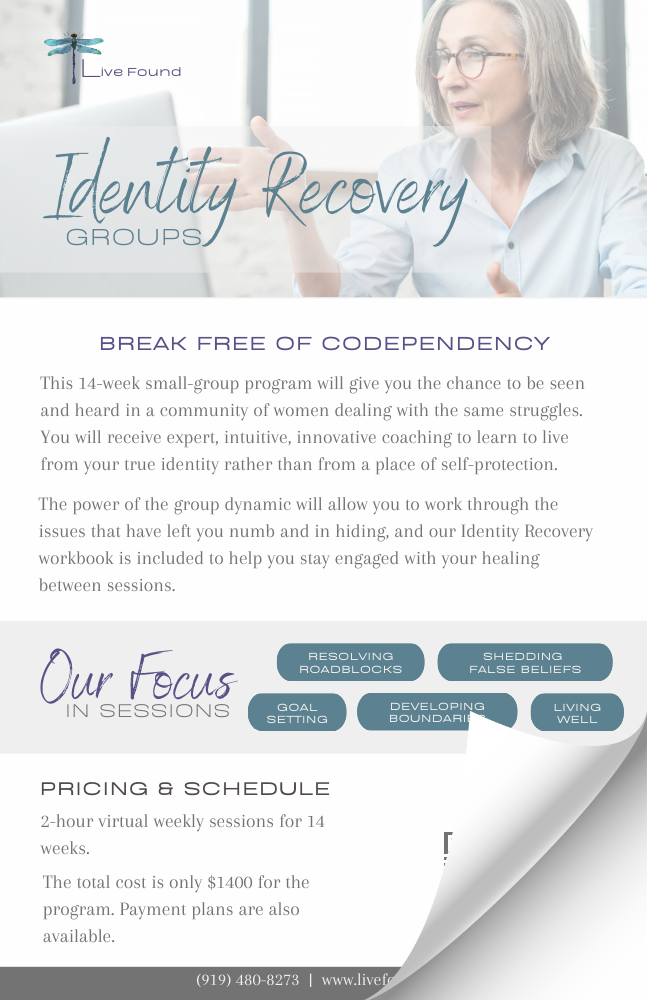
If you need help learning to tell the difference between someone’s words and someone’s pattern — between waiting and living — that’s exactly the work we do inside Identity Recovery Groups. You can start with the free Emotional Check-in Worksheet.
Find yourself. Keep yourself.
This is also the work the boundaries course was built for — not scripts to win arguments, but the framework underneath them. Self-paced, and a powerful launch into developing your sense of agency after identifying the nonsense you’ve put up with for far too long.
About the author. Sharmen Elaine Kimbrough is an identity strategist and the founder of LiveFound, Inc. She holds a Master’s degree in professional counseling and spent more than ten years developing and leading the women’s programs at the Marriage Recovery Center. She writes for women recovering a self after emotional abuse, coercive control, and spiritual bypassing. More about Sharmen →