
The Thing About the Scroll
We live in a world architecturally designed to pull you outward.
Scroll. React. Consume. Compare. Desire. Repeat.
And I’m not here to be preachy about screen time — that’s not the point. The point is what’s underneath the scrolling. Because nobody picks up their phone at 11pm because they genuinely want to watch another person’s morning routine. They pick it up because something inside them is restless, or lonely, or quietly asking a question they don’t have the language for yet.
We are chasing something in all that noise. The question is — what?
I think what we’re actually chasing is the feeling of being fully known. Of mattering. Of being seen in a way that goes all the way down. And the cruel trick of the feed — the highlight reel, the curated aesthetic, the inspiring story — is that it imitates that feeling without ever delivering it. It gives you the emotional hit of connection without any of the rootedness. So you need more of it, faster, because the last hit didn’t land anywhere real.
It’s like eating food with no nutritional value. You can consume a lot of it and still be starving.
And here’s the part nobody talks about: the longer you feed the hunger with the wrong thing, the less you can hear what you’re actually hungry for. The noise becomes the norm. The restlessness becomes background static. And one day you look up and realize you haven’t made a real decision about your own life in longer than you can remember. You’ve just been reacting. Responding. Consuming.
And quietly — incrementally — disappearing. That is not a small thing. That is your life.
What the Longing Is Actually Pointing To
Here’s the thing that stops me every time I sit with this:
All of that longing — that hunger to be seen, to matter, to feel the weight and beauty of your own life — that was put there by God.
It’s not weakness. It’s not vanity. It’s not something to manage or suppress. That hunger is holy. It’s a homing signal. And most of us have been pointed in the wrong direction.
We’re looking out there — at the woman with the aesthetically curated life, the one who seems to have figured out the thing you’re still working on, the story that stirs something in you that you can’t quite name — and we’re treating that as the destination.
But what if that stirring isn’t pointing you toward them?
What if it’s pointing you back to yourself?
Because here’s what I believe: when someone else’s story moves you — when it wakes something up — it’s not because they have something you don’t. It’s because they’re reflecting something back to you that God already placed inside you. The longing, the capacity, the beauty you see in them? It’s a mirror. It’s showing you the shape of something that’s already there, waiting to be lived.
You were not made to be a spectator of glory. You were made to carry it.
And if that’s true — and I believe it is — it changes everything. It means the life you’ve been watching for is not someone else’s to give you. It’s yours to build. And the only thing standing between you and that life is whether you’re willing to turn your attention inward long enough to find out who’s actually there.
What the Comparison Trap Is Actually Costing You
We’ve started to believe that if something isn’t extraordinary, it isn’t worthy. That if your life doesn’t look like a certain kind of story, it doesn’t count as much.
But I want to name what that belief is actually costing you.
It keeps you permanently adjacent to your own life. Always watching, comparing, wishing, waiting — but never quite stepping in. Never quite claiming it.
So I want to ask you something right now, and I want you to actually sit with it:
What would it feel like to wake up tomorrow already knowing — not from a reel, not from someone else’s approval, not from a quote you saved — but from somewhere deep and settled inside yourself — that you are enough for this day? That you know what you value. What you need. What you’ll stand for and what you won’t.
That is not a fantasy. That’s what identity work produces. But it requires you to stop outsourcing — and start inhabiting.
The life you’re living right now — the one that feels too ordinary, too complicated, too unfinished — is the only life in which you can become the person you were created to be. Not her story. Not the version of you in better circumstances. This one. Now.
What Happens When You Know Who You Are
When you know who you are — not who you should be, not who someone else decided you were, but who God actually made you at the level of soul — something shifts.
You stop chasing. Not because you’ve transcended desire, but because you’ve found something to stand on.
You can be in the noise without being taken over by it. You can appreciate someone else’s story without losing the thread of your own. You can be moved, inspired, challenged — without dissolving. Because your sense of self isn’t borrowed anymore. It’s yours. It’s rooted.
And from that place, something remarkable happens in your relationships. When you show up to someone else without an emptiness that needs to be filled — when you’re not looking to them to confirm your worth — you become someone who can actually be present to them. Not performing connection. Not clinging. Not terrified of losing it.
Just there. Steady. Genuinely curious about them.
That’s the kind of presence that changes rooms. That changes families. That changes communities. And it doesn’t come from having the right aesthetic or the most followers. It comes from the inside work — the unglamorous, sacred, deeply worth-it work of finding out who you actually are, and then choosing, again and again, to live from that place.
A Starting Place
If you’ve been nodding along — if something in you has been recognizing itself in what you’re reading — I want to offer you a first step.
Not a program. Not a list. A tool that helps you slow down and start listening to what’s actually happening inside you.
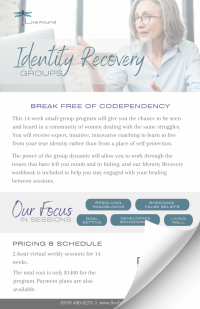
The Emotional Check-in Worksheet is what I use at the beginning of every Identity Recovery Group I run. It helps you tune in to your own interior experience — which is where this work has to begin. You can’t build a grounded life from the outside in. You have to start with what’s actually there.
Download it free: Emotional Check-In Worksheet
And if you’d like to understand more about what happens when an environment systematically pushes you out of yourself — which is exactly what coercive control and emotional abuse do — this is worth reading next:
🔗 Internal link: ‘What Is Coercive Control? What Women in Difficult Marriages Need to Know’
Find yourself. Keep yourself.
— Sharmen Elaine Kimbrough | LiveFound, Inc. | livefound.org