It Doesn’t Start With a Fist
When most people hear the word abuse, they think of something visible. Something undeniable. Something that would hold up in a conversation, in a courtroom, in a church office.
Coercive control rarely looks like that — especially not at first.
It looks like a partner who is intensely attentive in the beginning. Who seems to know exactly what you need. Who makes you feel more seen than you’ve ever felt. And then, slowly, the dynamic shifts. The attentiveness starts to feel like monitoring. The care starts to feel like conditions. The relationship that felt like coming home starts to feel like a cage you can’t quite describe to anyone else — because there are no visible bars.
That’s by design.
Coercive control is not a single incident or a bad night. It is a pattern — a systematic, often invisible pattern of behavior that uses tactics like isolation, surveillance, manipulation, financial control, and yes, sometimes spiritual language, to establish dominance over another person’s choices, identity, and sense of reality.
She hasn’t lost herself. She’s been systematically pushed out of herself.
And that distinction matters more than I can tell you. Because the woman sitting across from me in a coaching session who says “I don’t even know who I am anymore” isn’t broken. She isn’t weak. She is the predictable, intelligent response to an environment that has been methodically engineered to erase her.
What Coercive Control Actually Looks Like
If you want the fuller picture — what it does to a person day after day, in her marriage, her body, her faith, her sense of what is even real — I’ve written it out in detail.
Because coercive control operates through patterns rather than isolated incidents, it can be extraordinarily difficult to name — especially when you’re inside it. Here are some of the markers I see most consistently in the women I work with:
- Constant monitoring or jealousy framed as love. Who you talk to, where you go, who you spend time with — tracked and controlled under the guise of protection or devotion.
- Isolation from support systems. Friends and family become “problems” or “bad influences.” Gradually, your world gets smaller.
- Erosion of financial autonomy. Control over money, access to accounts, or financial decision-making that keeps you dependent.
- Reality distortion. What you know you experienced is questioned, reframed, or denied. You begin to doubt your own memory and perception. This is also called gaslighting.
- Emotional unpredictability. You become hypervigilant, always reading the room, always managing their emotional state — because the cost of getting it wrong is too high.
- Conditional love and approval. Affection and acceptance are used as reward and punishment. You learn to perform rather than just be.
None of these require physical violence to constitute abuse. And all of them, over time, do profound damage to a person’s sense of self, their ability to trust their own instincts, and their capacity to make autonomous decisions about their own life.
And if what you recognize most is the crazy-making that has you doubting your own memory, that has a name too, and a way out.
The Spiritual Dimension — What the Church Often Misses
If you are a woman of faith navigating this, you are carrying something extra.
This deserves more than a simple section on a page. How Scripture gets turned into leverage — submission, forgiveness, headship — is its own kind of harm, and it needs naming on its own terms.
Because coercive control in faith communities frequently weaponizes theology. Scripture gets used to enforce compliance. Submission gets redefined as silence. Forgiveness gets used as a reason you’re not allowed to have boundaries. And the church — with all the best intentions — can become one more voice telling you to stay, to try harder, to be more gracious.
It isn’t only that the church misses it. It’s why people who should know better refuse to see it — even when she finally says it plainly.
This is what I call spiritual bypassing: the use of spiritual language and religious frameworks to sidestep, suppress, or invalidate a person’s real experience of harm.
And I want to say something directly to you if you’re sitting in this:
Love ceases to be love when free will is removed.
That is not a radical statement. It is theologically sound. The entire framework of the gospel rests on the premise that love requires the genuine possibility of choice. A God who is love — who built love into the very fabric of creation — did not design intimate relationship to be a place where one person’s will is systematically overridden by another’s.
What is happening in a coercively controlling relationship is not a marriage that needs more prayer. It is a power structure that needs to be named.
Why It’s So Hard to See — and Even Harder to Leave
One of the most disorienting features of coercive control is that it dismantles the very tools you would need to recognize and respond to it.
Your trust in your own perception gets eroded. Your support network gets reduced. Your sense of self gets hollowed out to the point where you’re no longer sure what you actually think, feel, or want — independent of what the relationship has told you to think, feel, and want.
Part of what keeps a woman in place is the promise that it will be different now. There are ways to tell whether the change you’re being promised is real — and they have nothing to do with how sorry he sounds.
And then someone asks: “Why don’t you just leave?”
As if leaving were simply a matter of deciding to. As if the woman in a coercively controlling relationship still has full access to the internal resources that decision requires — clarity, confidence, a stable sense of self, trust in her own judgment, a support system, financial independence.
She may have lost access to all of those things. Incrementally, over years, through a process so gradual it didn’t register as loss until one day she looked up and didn’t recognize herself.
That is not weakness. That is the mechanism working exactly as it was designed to.
What Recovery Actually Requires
When you’ve been told for years that you’re too sensitive, you lose the ability to judge what’s normal. There’s one simple question that cuts through it — would he say that to anyone else?
Here’s what I’ve learned after more than a decade of working with women in these situations:
Information alone does not heal this.
You can understand coercive control perfectly — read every book, watch every video, check every box on every list — and still find yourself unable to move. Still second-guessing. Still waiting for permission. Still managing someone else’s emotions before your own. Still living as though your life belongs to someone other than you.
That’s because the damage isn’t primarily informational. It’s identity-level.
What coercive control dismantles is your relationship with yourself. Your trust in your own perception. Your sense of agency — the belief that your choices matter, that you are a subject of your own story rather than an object in someone else’s.
Recovery, then, is not a process of accumulating more information. It is a process of returning to yourself. Rebuilding, from the inside out, a settled, grounded, trusted sense of who you are — so that you can navigate your own life with clarity, dignity, and something that looks like freedom.
She was not made to be managed. She was made to be known — by God, and by herself.
That process has a shape. In my work, I call it the Identity → Discernment → Guardrails → Agency framework. You cannot build effective guardrails — what most people call boundaries — without first knowing who you are. And you cannot know who you are when you’ve spent years in an environment designed to answer that question for you.
So the work starts there. With identity. With coming home to yourself. With learning to trust the voice inside you that has been trying to get your attention for years.
You Haven’t Lost Yourself. You’ve Been Pushed Out.
I want to end here, because this is the thing I most want you to carry with you after reading this.
The woman who comes to me after years in a coercively controlling relationship almost always describes herself the same way: “I don’t know who I am anymore. I feel like I’ve disappeared.”
And every time, I say the same thing:
You haven’t disappeared. You’ve been pushed. There is a difference — and it matters enormously.
Because if you’ve disappeared, recovery means reinventing yourself. Starting from scratch. Building something new.
But if you’ve been pushed out of yourself — systematically, over time, by an environment designed to do exactly that — then recovery means something different. It means finding your way back. It means recovering what was always there: your voice, your instincts, your values, your capacity, your particular, irreplaceable way of being in the world.
If you’re ready for what comes next, there are three steps to start finding your way back — and none of them require him to change first.
God put something specific in you. Not a generic template of what you’re supposed to look like. Not the version of you that someone else found more convenient to live with. Something real, and particular, and worth finding.
The Hebrew word ezer — used to describe the woman in Genesis — doesn’t mean helper in the diminutive sense. It means a strong, capable, active force. It’s the same word used to describe God as Israel’s help in the Psalms. You were not made to be background. You were made to be present, grounded, and genuinely yourself.
That is what you’re recovering. And it is entirely possible.
Ready to Take the First Step?
If this resonated with you — if you’ve been sitting with a quiet sense that something is wrong but haven’t had the language for it until now — I want to offer you a starting place.
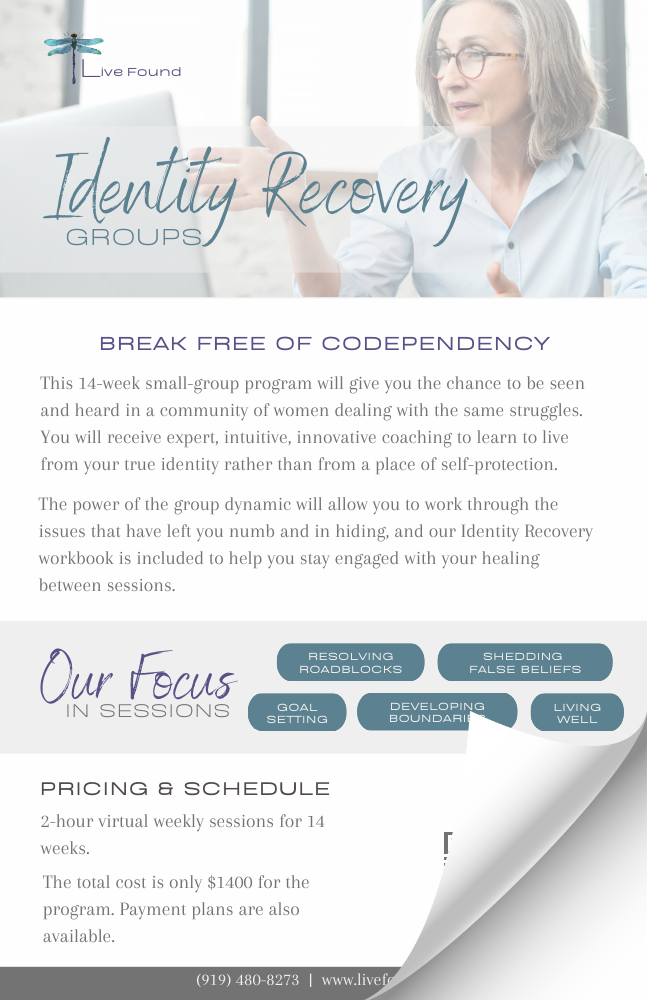
The Emotional Check-in Worksheet is a tool I use at the beginning of every Identity Recovery Group I run. It helps you slow down, tune in, and start learning the language of your own interior experience — which is exactly where this work begins.
Download it free here: http://www.livefound.org/worksheet
And if you’re ready to go deeper — to do the structured, supported work of rebuilding your identity and your agency from the ground up — the Boundaries course is built for exactly this moment.
Explore the Boundaries course here.
You don’t have to figure this out alone. And you don’t have to stay lost.
Find yourself. Keep yourself.
About the Author
Sharmen Elaine Kimbrough is an Identity Coach and Strategist, and the Founder and CEO of LiveFound, Inc. She holds a Master’s degree in Professional Counseling and brings more than a decade of specialized clinical experience working with survivors of coercive control, narcissistic abuse, and spiritual bypassing. Her work is faith-integrated, forward-facing, and grounded in the belief that every woman can find herself — and keep herself. Learn more at livefound.org.