
The Glue of Attachment
Attachment is what holds humanity together — the heartbeat of our emotional, physical, and spiritual survival. We are wired for connection. We crave it, not just for comfort, but for existence itself.
Think about babies: they need more than just a bottle and a clean diaper to thrive. Without cuddles, eye contact, and the warmth of being responded to, they risk “failure to thrive” — a condition that can stunt development or, in severe cases, lead to death. It is a stark reality that reveals something essential: attachment is not optional. It is in our design. It is a biological, emotional, and spiritual lifeline.
When trauma disrupts this bond, it doesn’t just hurt. It fractures the very connections that define who we are and where we belong. This is why I say, with clinical conviction and personal conviction both:
Trauma is an attachment injury.
And that changes what healing has to look like.
Trauma: A Wound to Belonging — Not Just Safety
When most people think about trauma, they think about safety. The threat that happened. The danger that was real.
But trauma’s deepest damage runs further than safety. It is a profound wound to our sense of belonging and being rightly known — which is what love, and relationship with God, actually require.
At its core, healthy attachment is about feeling seen, valued, and anchored in relationships that affirm your identity. Trauma — whether from a single devastating event or the slow erosion of safety in an abusive relationship — severs that anchor. It tells you that you are not valued, not worthy, or not truly known. And it leaves you adrift in a world that can feel hostile or indifferent.
The messages trauma plants are insidious precisely because they don’t feel like lies. They feel like conclusions. Like things you finally understand about yourself:
- You are alone.
- You are too much — or not enough.
- You have to protect yourself, because no one else will.
- You are not worthy of being fully known.
These are not truths. They are wounds wearing the costume of insight. And they rewrite your internal narrative in ways that affect every relationship, every decision, every moment of connection or disconnection that follows.
Consider Adam and Eve after the fall. God came looking and asked, “Where are you?” — not because He didn’t know their location, but because He wanted them to reckon with where their hearts had gone. Their sin had shattered intimacy, and shame had driven them into hiding. That question was an invitation back. Trauma does the opposite — it tells you that hiding is the only safe answer. That being found is too risky.
What This Looks Like in a Destructive Relationship
In the context of coercive control and emotional abuse, attachment injury doesn’t arrive in a single dramatic moment. It is administered slowly — through repeated experiences of having your reality denied, your needs dismissed, your voice overridden, and your sense of self quietly but systematically replaced by someone else’s version of you.
Over time, this produces a particular kind of disorientation. You stop trusting your own perceptions. You begin to experience your needs as burdens. You learn to read another person’s emotional state before you check in with your own — because the cost of getting it wrong is too high. You become hypervigilant, expert at managing, and progressively less connected to yourself.
This is not weakness. This is the predictable outcome of living inside a system designed to produce exactly this result. You were not broken by it. You were pushed out of yourself by it.
And that distinction is not semantic. It determines everything about what recovery requires.
🔗 For a deeper understanding of coercive control and how it works, read: ‘What Is Coercive Control?‘
Hiding: The Safety Trap
Hiding is trauma’s default defense. It’s the armor we build when being truly known has become too dangerous to risk.
In clinical terms, we talk about this through attachment styles: anxious types cling desperately for reassurance, avoidant ones build walls, and disorganized types oscillate between the two, never quite landing anywhere safe. Each style is a survival strategy born from the conviction — conscious or not — that authentic connection leads to pain.
In the context of faith, hiding often gets reinforced by something else: the FOG that comes with coercive relationships — Fear, Obligation, and Guilt. These three forces keep women trapped not just because they fear what will happen if they leave or speak up, but because they genuinely believe that staying small, staying silent, and staying hidden is what faithfulness requires.
It isn’t. And I want to say that clearly, because I have sat with too many women who have stayed lost in the name of faithfulness when what God was actually inviting them toward was wholeness.
Recognizing your hiding pattern — and understanding that it was a rational response to an irrational environment — is not self-indulgence. It is a compass. It shows you where the work needs to go.
Healing: Love Needs a Dance Partner
Healing from attachment injury means stepping out of hiding and reclaiming your right to be known.
Not performing okayness. Not pretending the wound didn’t happen. Not getting strong enough to not need anyone. Being known — actually, genuinely, vulnerably present in your own life and in relationships where that presence is safe.
Love, at its essence, needs a recipient to be complete. Without someone to receive it, it echoes in a void. Healing follows the same principle. It happens in relationship — with God, with safe people, with a skilled guide who can reflect your real worth back to you when you can’t yet see it yourself.
This is why healing in isolation has limits. It’s also why the first step isn’t strategy or skill-building. The first step is connection — with your own interior world, with the truth about what happened to you, and with the God who has been asking “Where are you?” with nothing but love in the asking.
The Road Back to Yourself: Where Identity Fits In
There is a sequence to this work that I have seen hold true across a decade of sitting with women in this place. And it matters:
Identity → Discernment → Guardrails → Agency
You cannot build effective guardrails — what most people call boundaries — without first knowing who you are. And you cannot know who you are when you have been living inside an environment that has been answering that question for you.
So the work starts with identity. With asking — and beginning to honestly answer — questions like: What do I actually feel? What do I actually value? What do I believe about myself when I strip away what I’ve been told? What does God say about who I am?
From that foundation, discernment becomes possible. You can begin to evaluate what’s actually happening in your relationships — not just what you’ve been told is happening. You can start to trust your own perception again.
From discernment, guardrails can finally function — not as rules you follow to avoid punishment, but as the natural expression of knowing what you’ll protect, because you’ve finally named what matters.
And from that place, agency becomes real. The ability to actually choose your life, rather than simply react to whoever demands the most of you at any given moment.
This is not a fast process. It is not linear. And it is not something you have to figure out alone. But it is available — to you, in your specific circumstances, with your specific history — because the self that was pushed out is still there. Still waiting. Still worth finding.
You Are Not Too Far Gone
The woman who sits with me in her first session almost always says the same thing: I don’t even know if there’s anything left to find. And every time, the work proves her wrong.
You have not disappeared. You have been pushed. There is a difference — and it is the difference between a story that ends in loss and one that ends in return.
God put something specific in you. Not a generic template of what you’re supposed to look like. Not the version of you that someone else found more convenient to live with. Something real, and particular, and worth finding — and worth the journey back.
She has not lost herself. She has been systematically pushed out of herself. And she can find her way back.
The road home starts with a single honest move toward yourself.
Take the First Step
The Emotional Check-in Worksheet is a tool I use to open every Identity Recovery Group — because before you can do anything else, you need to know what’s actually happening inside you. It’s free, it’s the right first move, and it will start to give you language for what you’ve been living.
Download it free: Emotional Check-In Worksheet
If you’re ready to go deeper with structured support:
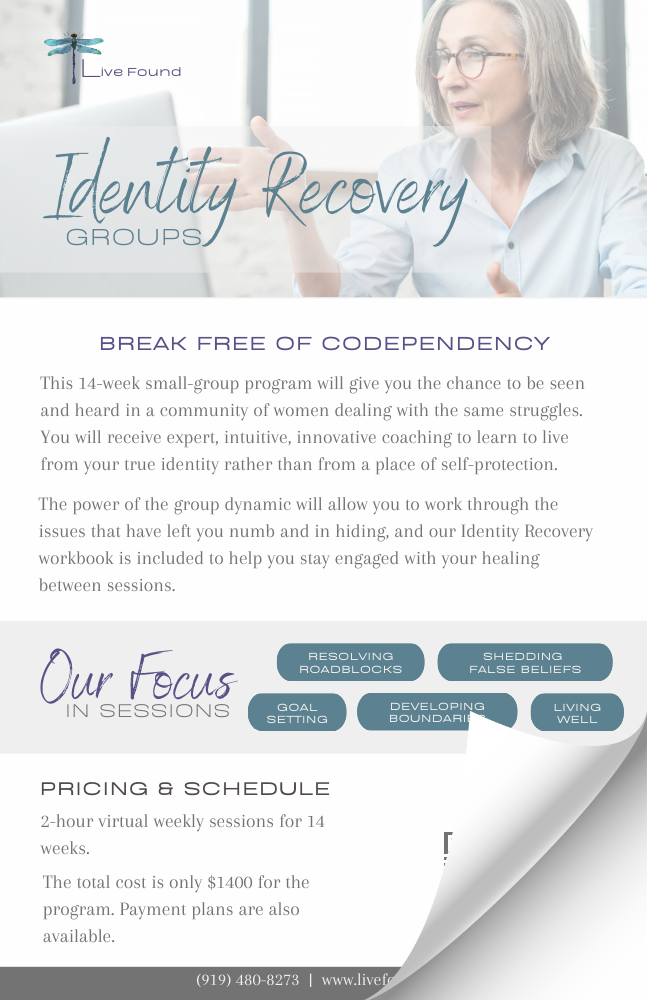
Identity Recovery Groups: https://livefound.org/recovery-groups/
Individual Coaching: https://livefound.org/booking-portal/
🔗 Also read: ‘I Don’t Know Who I Am Anymore: Three Steps to Begin Healing After Emotional Abuse’
Find yourself. Keep yourself.
— Sharmen Elaine Kimbrough | LiveFound, Inc. | livefound.org