
Have You Been Wandering Around Lost?
You didn’t plan to end up here.
You didn’t wake up one day and decide to feel numb, confused, or hollowed out. You didn’t choose to become the person who second-guesses everything — her own memory, her own judgment, her own sense of what’s real.
But here you are. And the words that keep surfacing — the ones you might have whispered to a friend, or thought in the quiet at 2am — are some version of this:
I don’t know who I am anymore.
I want you to hear something important before anything else: you are not crazy. And you are not alone in this.
The women who find their way to me after living in destructive, coercively controlling, or emotionally abusive relationships almost always use the same language. I feel numb. Nothing makes sense. I don’t recognize myself. I’m so confused. I don’t know how I got here. And they all want to know the same thing: Is this fixable? Can I find my way back?
The answer is yes. But the path there is not the one most people expect.
First: Why the Confusion Isn’t Weakness
Before we talk about steps, I need to name something that shapes everything that follows.
The disorientation you feel is a predictable, intelligent response to an environment that has been methodically dismantling your ability to trust yourself. The confusion isn’t weakness. It’s the natural result of what was actually being done to you.
Coercive and emotionally abusive relationships work precisely by eroding the internal tools you would need to navigate them clearly — your trust in your own perception, your confidence in your own judgment, your sense of what you deserve, your connection to your own needs, values, and instincts.
It doesn’t happen overnight. It happens gradually — so gradually that most women can’t point to the moment things shifted. They just know that somewhere along the way, they stopped being able to hear their own voice above the noise of managing someone else’s emotions, walking on eggshells, keeping the peace, and trying to figure out what version of themselves would finally be enough.
She hasn’t lost herself. She’s been systematically pushed out of herself.
That distinction matters enormously. Because it means what you need is not reinvention — it’s return. You are not starting from scratch. You are finding your way back to someone who has been there all along, waiting for you to come home.
🔗 To understand the dynamics that create this disorientation, read: ‘What Is Coercive Control?’
Step One: Recognize and Validate Your Experience
The first step is the one most resisted — and most essential.
You have to let what happened be real.
Not the version you wish had happened. Not the story that makes everyone comfortable. Not the narrative you’ve been handed that keeps the peace or protects someone else’s image. What actually happened — in your body, in your experience, in the interior of your life that no one else fully saw.
Many women in emotionally abusive situations have been told — sometimes explicitly, sometimes through years of subtle messaging — that their perception is the problem. That they’re too sensitive. Too emotional. Too demanding. Not enough. That the confusion and pain they’re experiencing is their fault, their failure, or their imagination.
Often they’ve internalized questions like: Am I crazy? Am I too demanding? Why is my partner always so angry? Can I fix this? Am I the problem? These questions are not random — they’re the product of an environment designed to redirect your attention away from what’s actually happening and back toward your own inadequacy.
The first act of healing is refusing to agree with that story anymore.
Your feelings are valid. Your experience is real. Your sense that something is wrong — even when you couldn’t name exactly what — was accurate. You were not the problem. You were responding, as any thoughtful, perceptive, feeling human being would, to an environment engineered to make you doubt everything about yourself.
Recognizing that is not self-pity. It is not weakness. It is the beginning of clarity — and clarity is where everything else starts.
Step Two: Establish Guardrails and Tend to Your Soul
This is where a lot of confusion shows up — because most people assume that “establishing boundaries” means learning to say no, memorizing scripts to use in conflict, or drawing lines that other people will respect.
And while those skills have their place, they’re not where this work actually begins.
Guardrails — what most people call boundaries — can only function when you know who you are clearly enough to know what you’re protecting. This is why my framework starts with identity, not rules:
Identity → Discernment → Guardrails → Agency
You have to start by knowing yourself. Not the version of you that has been shaped by years of someone else’s interpretation. Not the version that has been performing, managing, appeasing, and shrinking. The version underneath all of that — the one with values, instincts, preferences, and a God-given design that didn’t disappear just because someone spent years telling you it wasn’t acceptable.
Part of this step is also what I call soul care — the practice of tending to your own inner world with the same seriousness and intention you’ve been pouring into everyone else’s. This means asking — and actually sitting with — questions like:
- What do I actually feel, right now, in my body?
- What do I actually need — not what I think I’m allowed to need?
- What do I enjoy, apart from what someone else has decided is appropriate for me?
- What matters to me? What are my values, when I’m honest?
These are not small questions. For women who have been living inside a coercively controlling relationship, they can feel impossible — because the environment has been answering those questions for you for so long that you’ve stopped asking them yourself.
That’s exactly why this step matters. And why it comes before guardrails, not after.
One more thing: you may still be in the difficult relationship when you begin this work. Healing doesn’t require the situation to be resolved first. It requires you to begin — even in the middle of the hard, even when nothing outside of you has changed yet.
🔗 For a deeper look at how trauma disrupts identity and attachment, read: ‘Broken Identity: Trauma as an Attachment Wound’
Step Three: Focus on Your Own Healing — Independent of the Outcome
This is the step that requires the most courage and the most reorientation of everything you’ve been taught about what it means to be a good partner, a faithful person, a committed spouse.
Your healing does not depend on your partner’s participation.
It does not depend on whether they change, whether they acknowledge what happened, whether the relationship recovers, or whether anyone else ever validates your experience.
That is hard to hear — especially for women who have been holding out hope that if they could just get the other person to understand, to see what they’ve done, to finally choose accountability and healing, then everything could be okay. That hope is understandable. It is also, in many situations, one of the things keeping women from beginning their own recovery.
Here is the reframe I want to offer: your identity is not determined by your relationship. It was not created by it and it will not be destroyed by it — unless you allow the relationship to remain the only mirror you look into to know who you are.
You are an individual within this relationship. You had a self before it. And that self — the real, rooted, God-designed you — is entirely capable of healing, growing, and reclaiming her life regardless of what the other person decides to do.
Your healing does not hinge on their approval. And that is not selfishness. That is the most spiritually grounded, psychologically sound, and relationally generous thing you can do — because a woman who knows herself and is healing is actually capable of true relationship. A woman who has given herself away completely and is waiting for someone else to give her back has nothing real left to offer anyone.
What This Work Produces
I want to give you a picture of what you’re moving toward — because healing without a destination can feel directionless.
Here’s what the women I work with describe on the other side of this process: they know what they feel. They trust what they perceive. They make decisions from their own values rather than from fear, obligation, or guilt. They can be in relationship — real, connected, intimate relationship — without losing themselves in it. They have a quiet, settled confidence that doesn’t come from perfect circumstances, but from knowing who they are even when circumstances are hard.
That is agency. The ability to actually choose your life rather than just react to it.
And it is available to you. Not when everything is resolved. Not in better circumstances. Starting now — with the next small, honest, courageous move you make toward yourself.
Take the First Step
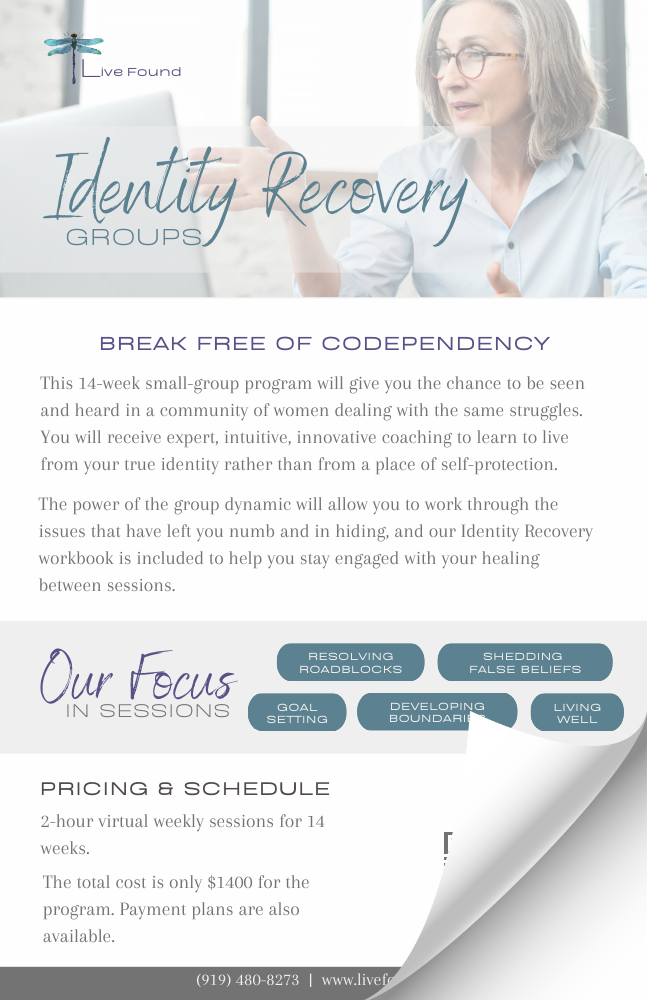
If you’re ready to begin — even just to begin beginning — start with the Emotional Check-in Worksheet. It’s a free tool I use to open every Identity Recovery Group I run. It helps you slow down and start listening to what’s actually happening inside you, before you try to do anything about it.
Download it free: Check-In Worksheet
If you’d like support as you do this work — with a coach who has walked alongside women in exactly this place — start here:
Book a session: https://livefound.org/booking-portal/
And if you want to explore the structured, community-based version of this work alongside other women on the same path:
Identity Recovery Groups: https://livefound.org/recovery-groups/
Find yourself. Keep yourself.
— Sharmen Elaine Kimbrough | LiveFound, Inc. | livefound.org