
What Is Spiritual Bypassing?
Spiritual bypassing is the use of spiritual or religious language, concepts, and frameworks to avoid, dismiss, or override genuine human experience — including pain, legitimate need, and the recognition of harm.
Spiritual bypassing rarely travels alone — it’s usually one arm of the wider pattern this sits inside.
The term was originally coined by psychologist John Welwood to describe the tendency to use spiritual practice to sidestep unresolved psychological wounds. But in the context of coercive and emotionally abusive relationships, it takes on a more targeted and damaging form: it becomes a weapon.
In these relationships, spiritual bypassing sounds like:
-
- “You need to forgive and move on. That’s what God requires.”
-
- “A good wife submits. This is your call to trust God through this.”
-
- “You’re being too emotional. You need to pray more and trust Him.”
-
- “God hates divorce. You made a covenant. You have to honor that.”
-
- “If you had more faith, you wouldn’t be struggling like this.”
-
- “You’re being deceived by the enemy. Your feelings are lying to you.”
None of these statements are entirely without theological basis — which is exactly what makes them so effective and so dangerous. They are real concepts, pulled from real tradition, deployed in service of silencing a person who is trying to name genuine harm.
Spiritual bypassing doesn’t just use God’s name. It uses God’s name to keep you from being known by God — or by yourself.
The Difference Between Genuine Faith and Weaponized Theology
I want to be careful here, because I am not suggesting that forgiveness, submission, covenant, or trust are bad theology. I believe in all of those things — deeply, and with full conviction.
What I am suggesting is that there is a profound difference between theology that leads people toward wholeness and theology that is deployed to enforce compliance.
Genuine faith invites. It draws people toward God, toward truth, toward healing, toward the full expression of who they were made to be. It holds space for grief, for doubt, for anger, for the long and nonlinear process of becoming.
Weaponized theology controls. It uses the language of faith to shut down questions, override perception, enforce silence, and keep a person in a position of powerlessness — all while framing that powerlessness as virtue.
Here is the test I come back to again and again, and I want you to hold it:
Love ceases to be love when free will is removed.
The entire architecture of the gospel rests on the premise that love requires genuine choice. A God who is love — who built love into the fabric of creation — did not design intimate relationship to be a place where one person’s will is systematically overridden by another’s and then baptized in religious language to make it palatable.
If the theology being applied to your situation is consistently producing shame, silence, smallness, and an erosion of your sense of self — it is not functioning as the gospel. It is functioning as a system of control. And that distinction matters more than almost anything else I could say to you today.
How Spiritual Bypassing Works in Practice
Understanding the mechanics helps you see it clearly — even when you’re inside it.
Spiritual bypassing in a coercive relationship typically operates on several levels simultaneously:
It reframes the victim’s experience as the spiritual problem.
Your pain, your perception, your legitimate response to harm all get spiritualized into evidence of your insufficient faith, your pride, your hardness of heart. The actual behavior of your partner is rarely examined. Instead, your reaction to that behavior becomes the issue. This is deeply disorienting because it takes the real problem and makes it invisible while keeping you perpetually focused on your own supposed failures.
It uses forgiveness as a silencing tool.
Forgiveness — one of the most genuinely profound and healing spiritual practices available to us — gets redefined as the obligation to minimize, excuse, and move on from harm without accountability, without change, and without any honest examination of what happened. This is not forgiveness. It is a theological hostage situation. Real forgiveness does not require you to pretend. It does not demand that you remain in harm’s way. It does not override your right to be treated with dignity.
It weaponizes submission.
The concept of wifely submission — already deeply misunderstood in many church contexts — becomes, in abusive relationships, a theological justification for total compliance. I want to offer a different reading: the Greek word for submission in Ephesians 5 is mutual. The verse directly preceding the famous passage instructs all believers to submit to one another. And the passage as a whole describes a husband who lays down his life for his wife — the way Christ did for the church. That is not a passage about a woman being required to comply with whatever her husband demands. It is a passage about mutual self-giving love. Coercion is not in the text.
It isolates you from support under the guise of spiritual protection.
Counselors who “don’t understand the spiritual dimension.” Friends who are “bad influences.” Family members who are “unsupportive of the marriage.” Outside voices become framed as threats to your faith or your covenant, and the very support systems that might help you see clearly get systematically removed — always with a spiritual rationale attached.
What the Church Sometimes Gets Wrong — And Why It Matters
I want to say something directly to those of you who have sought help from your church community and come away feeling more confused, more ashamed, or more trapped than before you asked.
The church, in many cases, is not equipped to recognize coercive control. Leaders with genuine love and genuine faith often apply genuinely good principles — communication, forgiveness, commitment, prayer — to situations that those principles were never designed to address. Coercive control is not a marriage communication problem. It is a power and abuse problem. And the application of marriage enrichment tools to an abusive dynamic does not just fail to help — it can actively cause harm, by validating the framework that keeps the victim focused on her own behavior rather than the real problem.
If you have been told to try harder, pray more, communicate better, extend more grace, or simply trust God — and the situation has not changed or has gotten worse — please hear this:
You did not fail your faith. Your faith was used against you. That is not the same thing.
There is a growing body of pastoral and clinical understanding around coercive control and spiritual abuse. You deserve a helper who has that understanding — not one who, with the best of intentions, hands you a tool that keeps you more stuck.
What Your Faith Actually Requires
Your faith does not require you to disappear.
It does not require you to be silent about harm, complicit in your own erasure, or endlessly available to be controlled in the name of covenant. The God who made you — who fashioned you with intention, who named you before you were born, who placed something specific and irreplaceable inside you — is not honored by your disappearance.
The Hebrew word ezer kenedgo, used to describe the woman in Genesis, does not mean subordinate helper. It means a strong, active, capable force — the same word used in the Psalms to describe God as the help and defender of Israel. You were not made to be background. You were made to be present, grounded, and genuinely yourself.
What your faith actually invites you toward is wholeness. Honest reckoning with what is true. The kind of courage that names harm rather than absorbing it indefinitely. The kind of trust in God that does not require you to pretend that what is happening is acceptable.
And here is the thing about spiritual bypassing that I most want you to carry with you: the antidote to it is not less faith. It is more honest faith. The kind that can hold both the reality of your pain and the goodness of God at the same time, without needing to collapse one to protect the other.
Beginning to Find Your Way Back
If you have been living inside spiritual bypassing, the first thing you need is not a theological argument — though I hope what I’ve shared here gives you some grounding. The first thing you need is permission to have your actual experience.
Your feelings are not evidence of weak faith. Your pain is not a spiritual failure. Your confusion is not the enemy trying to deceive you. These things are real, and they are data — data about what has been happening to you, and about what needs to be different.
Healing after spiritual bypassing requires rebuilding two things that have been systematically damaged: your relationship with yourself, and your relationship with God as something other than a tool of control. That work is possible. I have watched it happen. But it requires a safe space — with people who understand what you’ve been through and won’t hand you the same tools that have already been used against you.
🔗 Read next: ‘What Is Coercive Control? What Women in Difficult Marriages Need to Know’
🔗 Also helpful: ‘Broken Identity: How Trauma Becomes an Attachment Wound’
A First Step
If you’re in this — if you’ve been told your pain is a faith problem, your perception is the enemy, your needs are pride — I want to offer you something concrete to begin with.
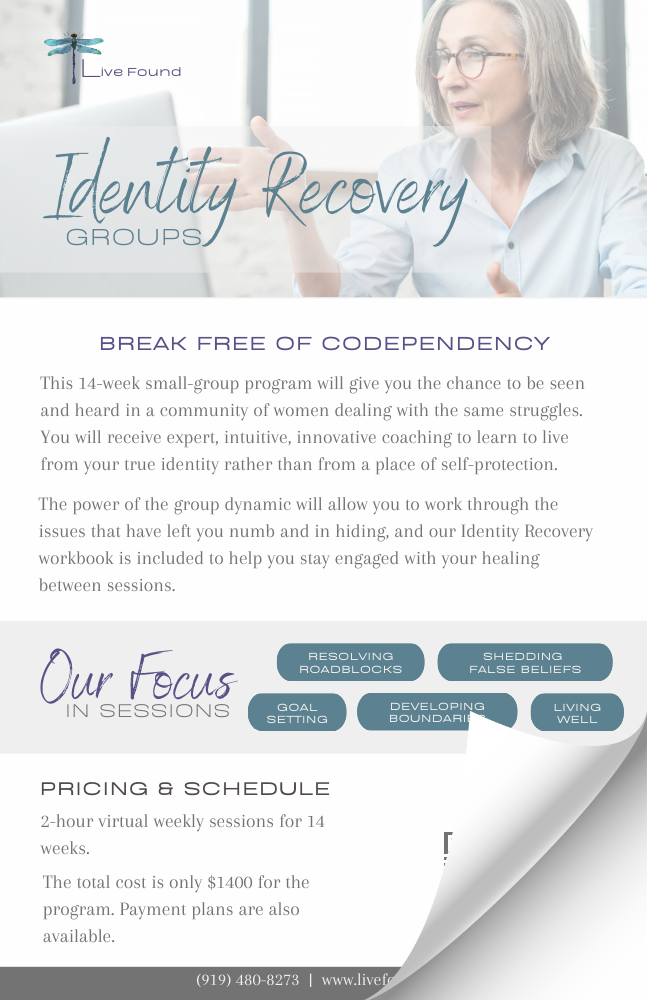
The Emotional Check-in Worksheet is a free tool I use at the start of every Identity Recovery Group. It slows you down, helps you tune in to what is actually happening inside you, and begins to give you language for your own experience — which is exactly where this work needs to start. You cannot find your way back to yourself without first learning to hear yourself.
Download it free: Emotional Check-in Worksheet
And if you’re looking for structured support alongside women who understand this specific terrain:
Your faith was meant to set you free. Not to keep you silent.
Find yourself. Keep yourself.
This is the work the boundaries course was built for — not scripts to win arguments, but the framework underneath them. And if you would rather not practice it alone, the Identity Recovery Groups are women doing exactly this, together.
About the author. Sharmen Elaine Kimbrough is an identity strategist and the founder of LiveFound, Inc. She holds a Master’s degree in professional counseling and spent more than ten years developing and leading the women’s programs at the Marriage Recovery Center. She writes for women recovering a self after emotional abuse, coercive control, and spiritual bypassing. More about Sharmen →