
Codependency After Abuse: A Survival Skill, Not a Character Flaw
We cannot get through life unscathed by trauma. Yet we often let trauma dominate our lives through denial, avoidance, fear, or naivete. Undealt with, trauma isolates us and leads to self-protection, manifesting as codependence or narcissism. Both extremes involve hiding oneself in order to manage the world around them. As natural nurturers, most women tend to lean toward codependency.
Which is why so many women arrive in my office already wearing that word as their identity.
Somebody gave it to them — a book, a counselor, a small group leader, sometimes the husband himself. You’re codependent. And it lands like a diagnosis: here is what is wrong with you, and it explains why your marriage is what it is.
It’s my opinion that the label might be informative, but only in classifying observed behavior, not in understanding the whole, authentic story.
The Label Gets Handed to the Wrong Person
Codependence gets described as a character flaw that predisposes a woman to abusive relationships. The logic runs backward from the outcome: she is in a destructive marriage, she over-functions, she cannot say no, therefore the flaw was there first and drew the trouble in.
That framing does something quietly devastating. It relocates the cause of the harm into the person who was harmed. It tells a woman who has spent years reading a room for danger that her vigilance is a personality defect. And it hands her a self-improvement project at exactly the moment she needs clarity about her circumstances.
Here is what I have watched instead, for more than a decade, in room after room:
Codependence and hyper-independence are learned self-protection mechanisms.
They are not flaws you brought to the relationship. They are, in most cases, skills you developed inside it — or inside the home you grew up in, and then carried forward because they had worked before.
When you are taught from childhood that safety equals compliant obedience, you learn compliance. When you are taught that no one is coming, you learn self-reliance. Either way, you develop a set of characteristics that a book will later label “codependence,” and an identity defined by pleasing others.
That is not a defect of character. That is a person who learned the room she was standing in.
Two Doors Out of the Same House
Codependency does not always look like clinging.
It can show up as hyper-independence — where you comply to a degree but shut down emotionally, hindering authentic connection. Outwardly this looks like the opposite of codependence. She is capable. She handles it. She does not ask for help and does not appear to need much.
But look at what both are doing. The compliant woman hides herself to keep the peace. The hyper-independent woman hides herself to stay safe. Different door, same house. Both are managing the world by making sure the real self is not available to be reached.
This is why women get so confused by the label. She reads a book about codependency, sees the clinging and the over-apologizing, doesn’t recognize herself, and concludes the problem must be something else. Meanwhile she has not told anyone the truth about her marriage in four years.
Hiding is hiding. The tell is not how needy you look. The tell is whether anyone gets to know you.
The Fine Line Between Codependence and Healthy Self-Defense
There is a fine line here, and I do not want to blur it. Not every accommodation is codependence. Sometimes what looks like people-pleasing is a woman making a shrewd, entirely appropriate calculation about how to stay safe in a house where honesty has a cost. That is not dysfunction. That is competence under threat.
The difference lies in the health and steadfastness of your sense of personhood, and in the degree of authenticity versus isolation.
A few questions that sort it, in my experience:
- Do you know what you actually think, or only what is safe to say? Managing your delivery is strategy. Losing access to your own opinion is something else.
- Is the accommodation chosen, or automatic? Can you decide not to smooth this one over, or does your body do it before you arrive?
- Does anyone know the truth? One person. A sister, a friend, a coach, a group. If the answer is nobody, the isolation has gone past protection.
- When the pressure lifts, do you come back? Healthy self-defense is a posture you can drop. Codependence has become the shape of you.
- What happens when someone is kind to you? If genuine care reads as suspicious, or as debt, the self-protection is running deeper than the situation requires.
- Are you managing his feelings or your own safety? Both are real. Only one of them is yours to carry.
If most of your answers land on the harder side of that line, it doesn’t mean you’re broken. It means the protection outlived the danger it was built for.
“Die to Self” When There is No Self Yet
I have to name the version of this that comes wrapped in Scripture, because for many of you that is the version that did the most damage.
A woman already trained into invisibility is handed teaching about servanthood, about dying to self, about laying down her life, about a gentle and quiet spirit. Each of those is a true thing in Scripture. Every one of them becomes a weapon when it is aimed at a person who has nothing left to lay down.
You cannot surrender what you do not possess. A self given freely is a gift; a self extracted under pressure is a theft, and calling the theft holiness does not change what happened. When Jesus laid down His life, He said plainly that no one took it from Him — He had authority to lay it down and authority to take it up again. Agency was the whole point.
So if you have been told that recovering a self is selfish, hear this clearly: you cannot offer God a person who does not exist. Getting yourself back is not a detour from obedience. It is the prerequisite.
Recovery is a Skill Set, Not a Personality Transplant
To live without self-protective people-pleasing, you need to train yourself for a healthy response — much like self-defense training.
I use that comparison deliberately, because of what it implies about effort. Nobody learns self-defense by deciding to be braver. You learn it by drilling a response so many times that it becomes what your body does when you don’t have time to think. That is exactly what happened to you the first time, in reverse: you drilled appeasement until it became automatic.
Which means retraining is slow, physical, repetitive, and completely possible. In practice it tends to look like this:
First, language. You cannot address what you cannot name. Most women spend the early weeks simply learning accurate words for what has been happening — coercive control, spiritual bypassing, gaslighting — and discovering that the confusion was manufactured, not personal.
Then, discernment. Learning to tell the difference between your read on a situation and the read you have been trained to accept. This is the stage where you stop asking am I overreacting and start asking what is actually happening here.
Then, guardrails. Small ones. A boundary is not an ultimatum; it is a statement about what you will do, not a demand about what he must do. Early ones should be small enough that you can hold them.
Then, agency. The point of all of it. Not a decision I make for you about your marriage, but you, clear-eyed enough to make your own — and steady enough to live inside it.
Recovery requires coming out of hiding and recovering your identity, which is the skill set that lets you live your life.
What Becomes Possible
What if clarity and healing are possible?
What if you could connect deeply with people without feeling obligated, angry, or afraid, and without hiding behind a facade? Imagine feeling heard, understood, and known, and using that as a source of strength to show up more steadfastly in your world. Imagine having even a few people in your corner who get it, and who help you fight against emotional abuse consuming your soul.
That is the power of a small group — and it is why I have spent over a decade coaching them, watching women find the turning point from a slow soul death to renewed life.
You are not alone in this. Connecting with other women who understand the death by a thousand paper cuts of a destructive relationship is itself part of the healing. For a lot of women, that hour is the only space in the week to be real, question the chaos, and find the clarity they crave.
If you recognized yourself somewhere in this, that recognition is the first honest thing — and it is more than you had this morning
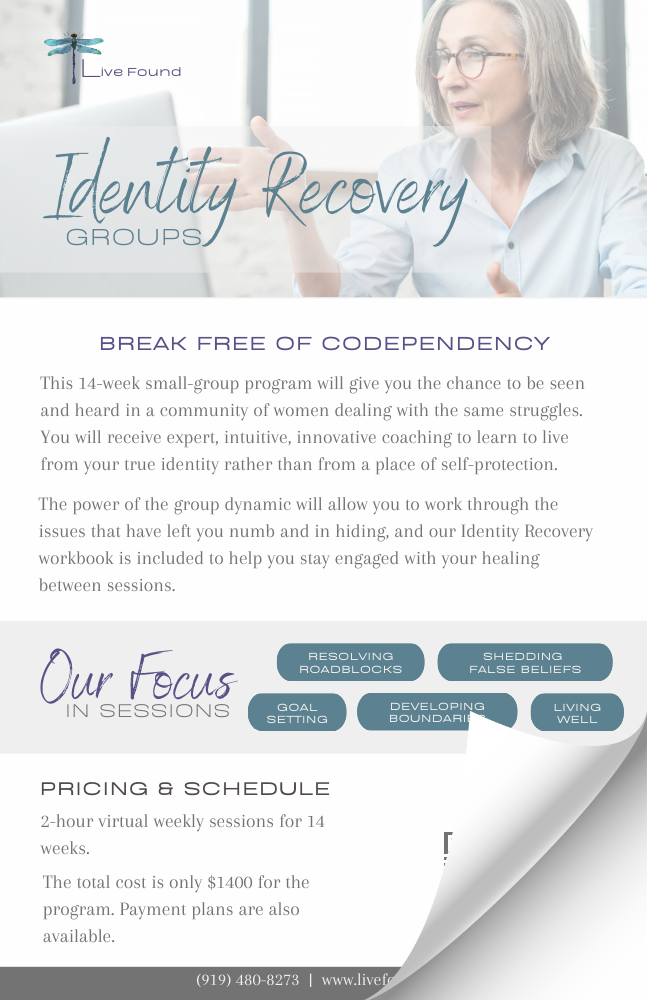
If some of this named something you have not had words for, that is where the work starts. Identity Recovery Groups meet online in small numbers, and they exist for exactly this — women learning to come out of hiding with other women who understand the terrain. You can also start on your own with the Tools for Healing guide.